
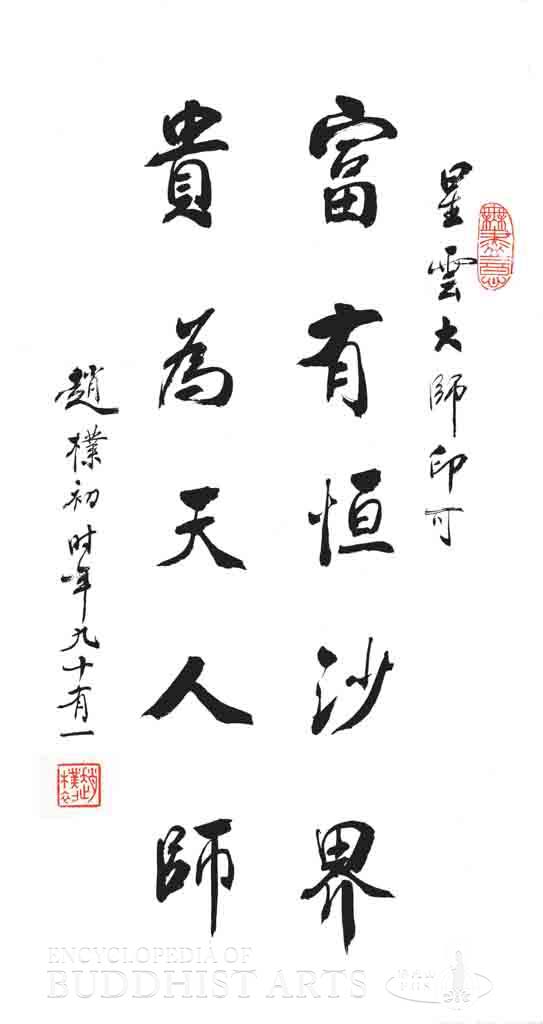
Fo Guang Shan Monastery: Calligraphy Dedicated to Master Hsing Yun
Ink on paper
Fo Guang Shan Monastery: Calligraphy Dedicated to Master Hsing Yun
TAIWAN, Kaohsiung
In his book entitled Diary of Hsing Yun, Master Hsing Yun of Fo Guang Shan Monastery was recorded to have made the following note: “The happiness of a monastic comes from worrying about the path and not about poverty. It can be burdensome for a monastic to possess too much money or receive too many favors. Only when one is clear of all burdens can they be free and easy; only then can they embrace a more expansive world. A truly rich person enjoys the wealth of realms innumerable as the sands of the Ganges.”
The last portion reading, “Wealth of realms innumerable as the sands of the Ganges,” was the inspiration for this scroll scripted by Zhao Puchu, which he dedicated to Master Hsing Yun. To this phrase, he appended his praise and deep admiration for Master Hsing Yun with the line, “Honored as teacher of heavenly and humans beings.” The main text of the scroll consists of two rows with five characters each.
Zhao Puchu’s calligraphic style suggests that of Li Yong of the Tang dynasty (618–907) and Su Shi of the Song dynasty (960–1279). However, he did not confine himself to the styles of these earlier masters by imitating their every move. Rather, he merely incorporated their character and line structures into his own works with grace and a fluid flow of qi. In this panel, the strokes are more rounded, imparting an added degree of harmony. The vitality of each brushstroke is represented by an even straightness which shuns any affectation of change.
For more details, go to the Encyclopedia of Buddhist Arts: Calligraphy, page 77.
Cite this article:
author = Hsingyun and Youheng and Youlu and Pokorski, Stefanie and Mankuang and Edson, Gary,
booktitle = {Encyclopedia of Buddhist Arts: Calligraphy },
pages = 77,
title = {{Fo Guang Shan Monastery: Calligraphy Dedicated to Master Hsing Yun}},
volume = 17,
year = {2016}}