
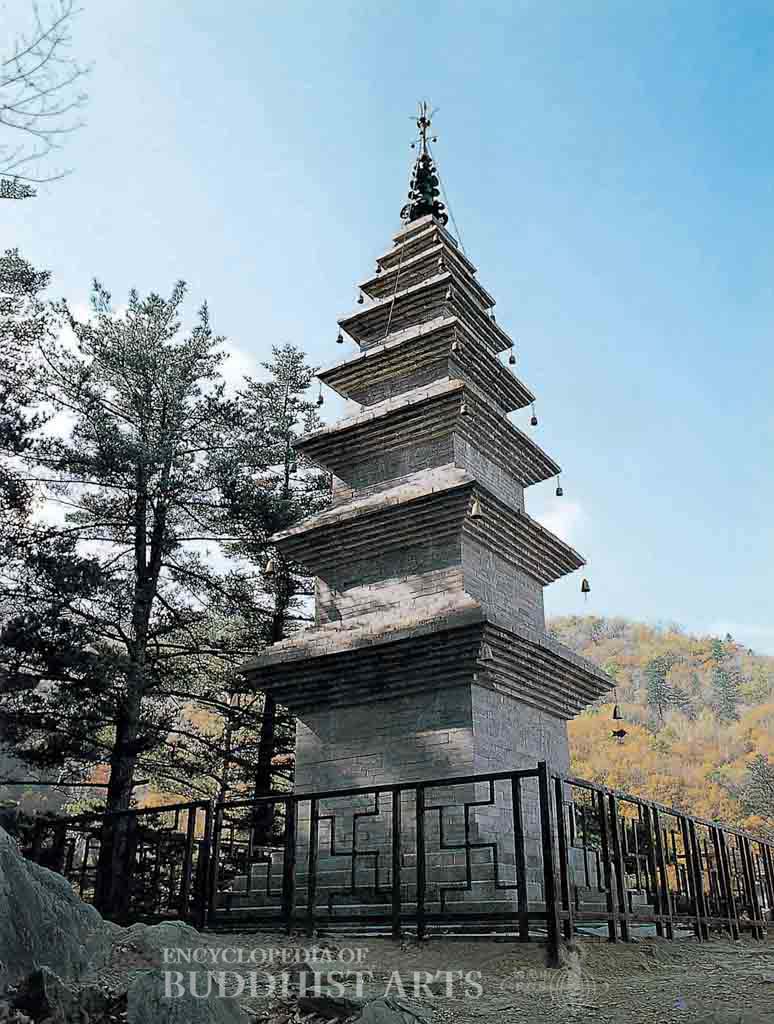
Jeongamsa Temple Agate Pagoda
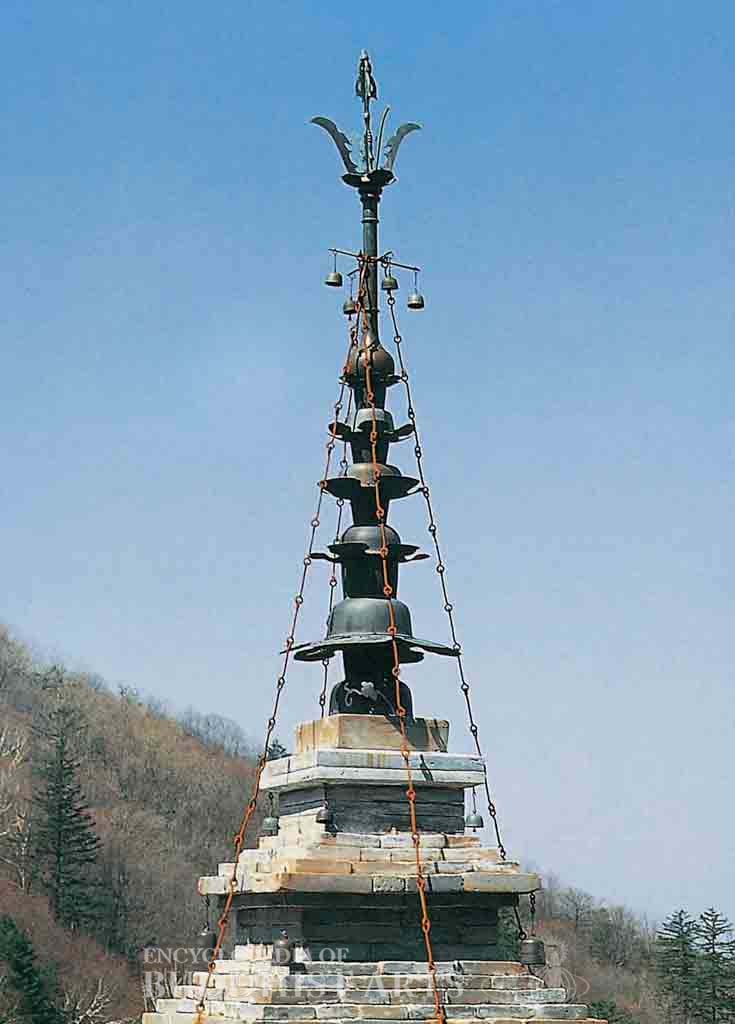
Jeongamsa Temple Agate Pagoda - Spire
Jeongamsa Temple Agate Pagoda
SOUTH KOREA, Gangwon, Jeongseon
This seven-tier stone pagoda is located behind the Nirvana Hall at Jeongamsa (Temple of Clean Rock). According to the records, the temple was established in 643 by Vinaya Master Jajang and the pagoda was built seven years later in 650. Legend has it that when Master Jajang was returning home from his studies at Wutaishan in China during the Tang dynasty (618–907), he called upon the Naga King of the Western Sea. The Naga King then took him to his palace and bestowed upon him a piece of agate, which Jajang used to build this pagoda for housing Buddha relics, prayer beads, and palm leaf manuscripts under its base. However, features of the pagoda suggest that it was built during the Goryeo dynasty (918–1392). It has been repaired and restored a number of times in its history, and was listed as Treasure No. 410 in 1964.
The 9 m high pagoda consists of a base, body, and spire. The base is made up of six layers of granite blocks whose size decreases with height. The pagoda body is built using bricks made from gray-green limestone. On the south side of the first tier there is a niche which is 70.5 cm high and 65 cm wide. At the entrance to the niche there is a stone slab incised with a door design with a metal handle. Wind chimes hang from the corners of all the eaves. The spire has a square harmika followed by five bronze stacked rings, a canopy, a wish-fulfilling jewel and a pronged finial.
When the pagoda was being restored in 1972, among the items excavated were reliquaries and five stone tablets recording the construction of the pagoda.
For more details, go to the Encyclopedia of Buddhist Arts: Architecture G-L, page 502.
Cite this article:
author = Hsingyun and Youheng and Johnson, Peter and Mankuang and Lancaster, Lewis,
booktitle = {Encyclopedia of Buddhist Arts: Architecture G-L},
pages = 502,
title = {{Jeongamsa Temple Agate Pagoda}},
volume = 2,
year = {2016}}