
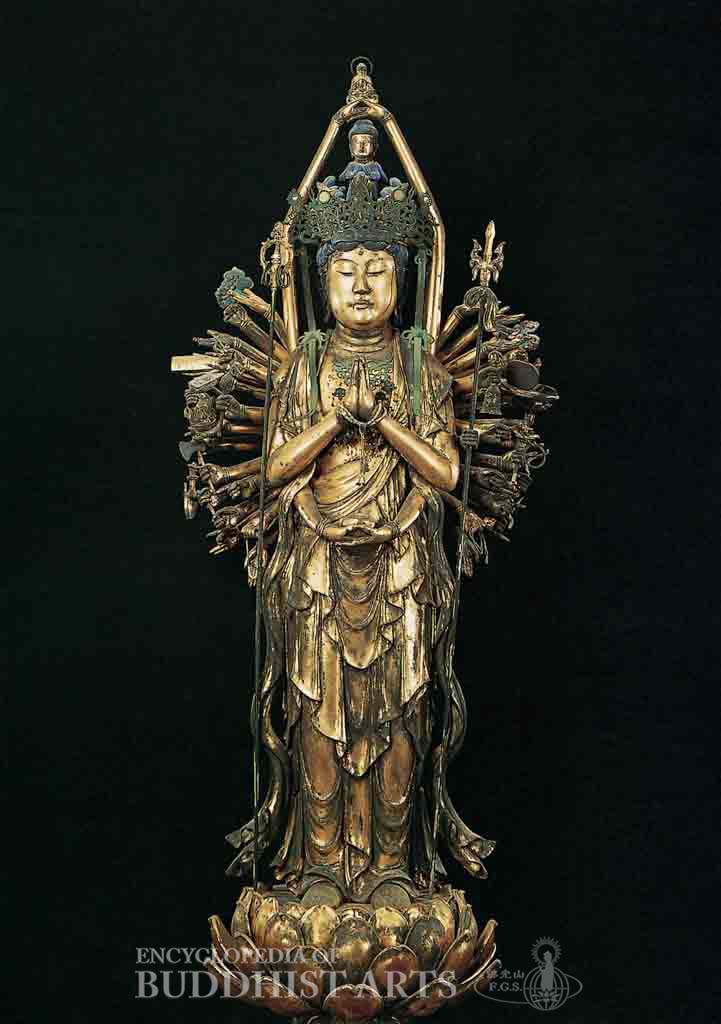
Kiyomizudera Temple Main Hall: Eleven-Headed, Thousand-Armed Avalokitesvara
Wood
Kiyomizudera Temple Main Hall: Eleven-Headed, Thousand-Armed Avalokitesvara
JAPAN, Kyoto; Edo period
It was said that the original statue of the Eleven-Headed, Thousand-Armed Avalokitesvara was carved during the Nara period (710–794), and is opened for public display only once every 33 years, to symbolize the Thirty-Three Manifestations of this Bodhisattva mentioned in the Lotus Sutra. For this reason, a copy of the original figure was created in the Edo period (1615–1868) and placed in front of the closed niche for daily veneration.
All but one of the faces arranged above the main head are hidden by the Bodhisattva’s openwork crown. An interesting feature of the statue is the seated meditating Buddha held above by a pair of the 42 arms that represent the nominal thousand. A braceleted pair of hands is raised in reverence at chest level and another pair cups an alms bowl below. The remaining arms are spread evenly in an arc around the body, holding different attributes or mudras. Rising the length of the body are a trident halberd on the right and a monk’s staff on the left, framing the stoles and robes that ripple harmoniously down to where the feet stand on a multi-layered lotus pedestal.
For more details, go to the Encyclopedia of Buddhist Arts: Sculpture G-M, page 533.
Cite this article:
author = Hsingyun and Youheng and Lovelock, Yann and Chou, Yuan and Huntington, Susan and Edson, Gary and Neather, Robert,
booktitle = {Encyclopedia of Buddhist Arts: Sculpture G-M},
pages = 533,
title = {{Kiyomizudera Temple Main Hall: Eleven-Headed, Thousand-Armed Avalokitesvara}},
volume = 11,
year = {2016}}