
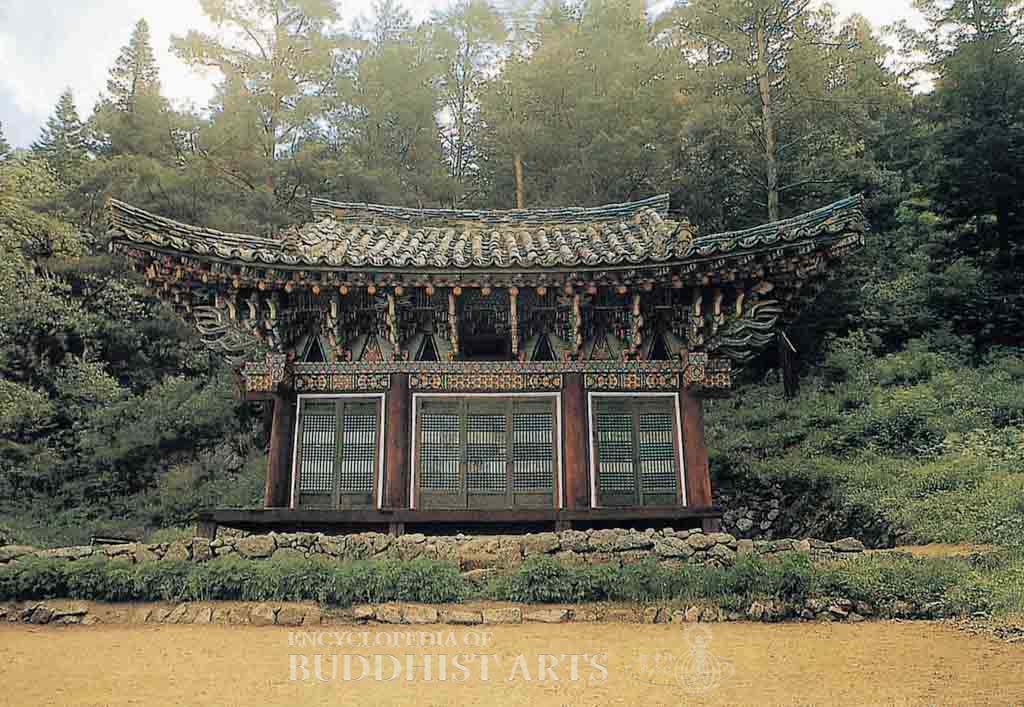
Jungheungsa Temple: Ultimate Bliss Hall
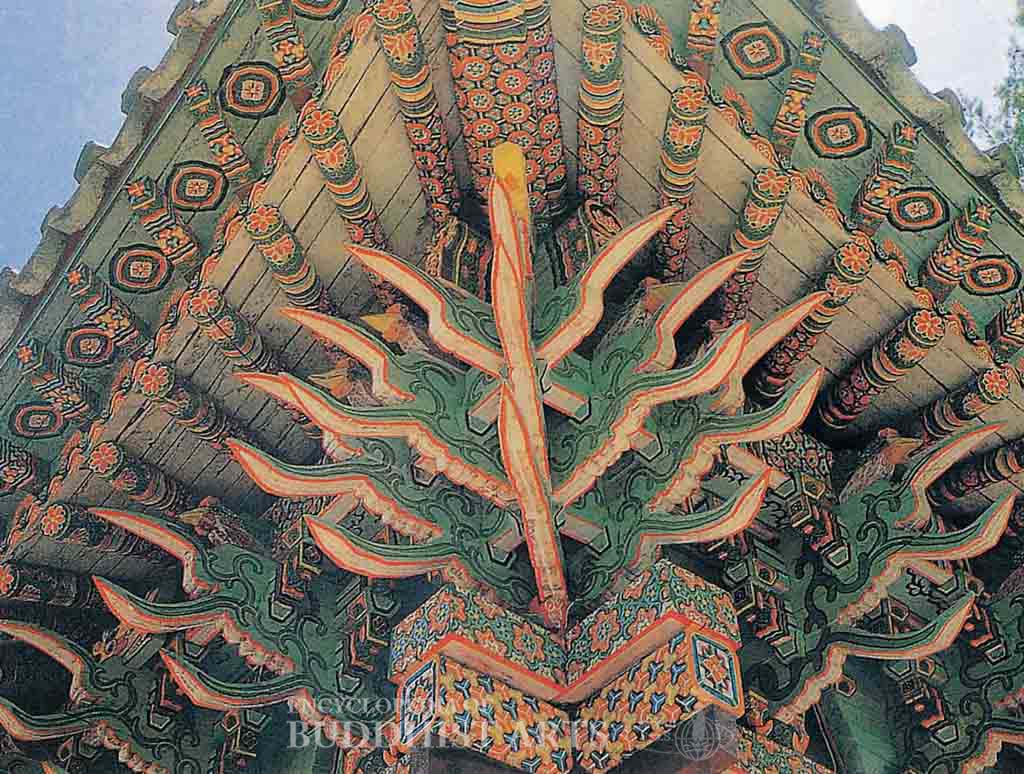
Jungheungsa Temple: Ultimate Bliss Hall (detail)
Jungheungsa Temple
NORTH KOREA, Yanggang, Samsu
Jungheungsa means Revival Temple. The temple’s construction year is unknown but it is thought to have been built in 1570 during the Joseon dynasty.
The only building currently still extant is the Ultimate Bliss Hall, but the temple complex originally included buildings such as the Seven Star Shrine and Mountain Deity shrine.
At the back of the Ultimate Bliss Hall there is a mural with an inscription dated 1713, which suggests that the building was most likely reconstructed before this date. The hall is a three-by-three bay structure built on a base of rocks. In the interior the roof is supported by three-tier bracket sets, while on the exterior two-tier bracket sets are used. The exterior bracket sets are in the shape of an ox tongue, whose style is reminiscent of the mid-18th century. The extended eaves create a sense of expansiveness.
For more details, go to the Encyclopedia of Buddhist Arts: Architecture G-L, page 559.
Cite this article:
author = Hsingyun and Youheng and Johnson, Peter and Mankuang and Lancaster, Lewis,
booktitle = {Encyclopedia of Buddhist Arts: Architecture G-L},
pages = 559,
title = {{Jungheungsa Temple}},
volume = 2,
year = {2016}}