
Goryeo Stupa
Goryeo Stupa
KOREA
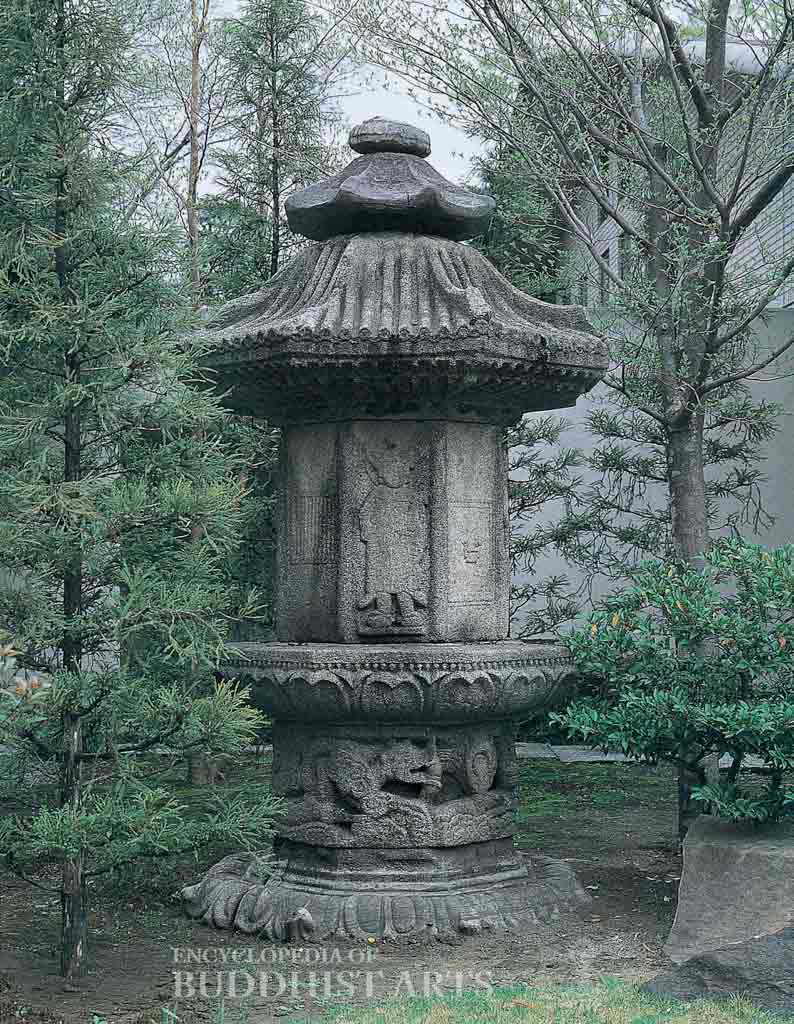
This Goryeo dynasty (918–1392) octagonal stone stupa is currently located at the Nezu Institute of Fine Arts in Tokyo. It has a height of 2.95 m and is carved from granite. It consists of a three-layer base, an octagonal central section, and a double-eave pyramidal roof surmounted by a jewel. The lower layer of the base is an inverted lotus, the middle layer has reliefs of two dragons with pearls in their mouths, and the upper layer consists of an upturned lotus. The octagonal central section has images of the Four Heavenly Kings on alternate sides, while two of the remaining sides have reliefs of mullioned windows and the other two sides have doors. The eaves are supported by imitation bracket sets.
This type of stupa was developed between the late Silla (668–935) and Goryeo dynasties. The images of the Four Heavenly Kings are simple and look static. It is thought that the stupa was made during the second half of the 10th century.
For more details, go to the Encyclopedia of Buddhist Arts: Architecture G-L, page 381.
Cite this article:
author = Hsingyun and Youheng and Johnson, Peter and Mankuang and Lancaster, Lewis,
booktitle = {Encyclopedia of Buddhist Arts: Architecture G-L},
pages = 381,
title = {{Goryeo Stupa}},
volume = 2,
year = {2016}}