
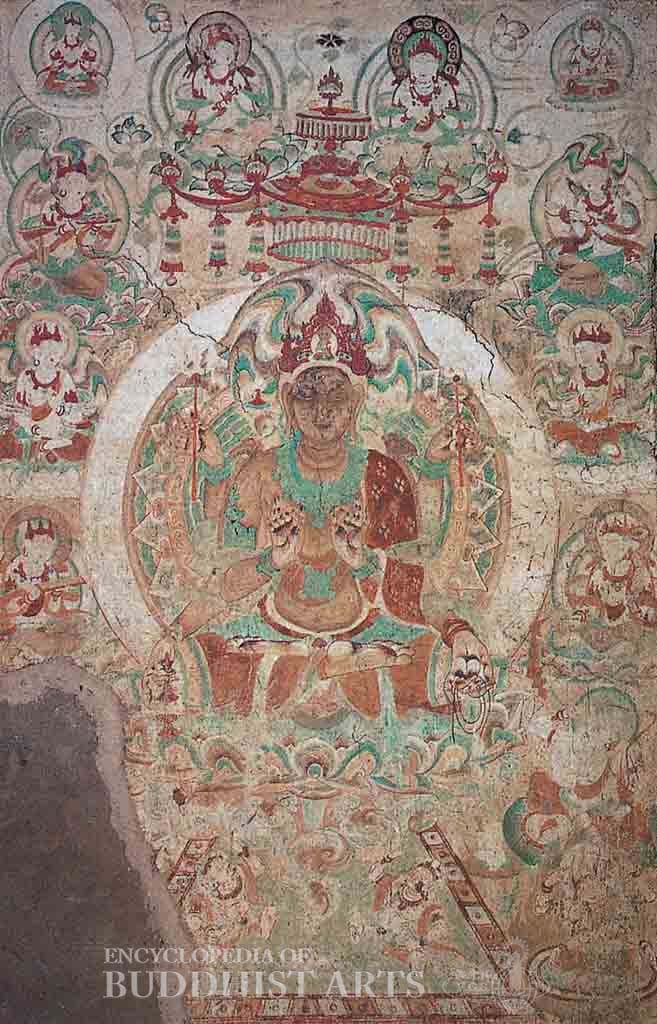
Western Thousand Buddha Cave 18: Amoghapasa Avalokitesvara
Western Thousand Buddha Cave 18: Amoghapasa Avalokitesvara
CHINA, Gansu, Dunhuang; Tang dynasty
This image is located on right side of the south wall. Amoghapasa Avalokitesvara is a popular manifestation of Avalokitesvara in Vajrayana Buddhism, and is always depicted alongside Cintamanicakra Avalokitesvara in the Dunhuang murals. The lasso held by this Bodhisattva represents the ability to draw sentient beings to the Dharma. The main colors employed in this painting are orange, green, red, and brown.
This painting depicts a Six-Armed Avalokitesvara seated in full lotus position on a lotus throne that grows from a pond beneath it. A two-tier, opulently adorned canopy is suspended above the figure’s head. The Bodhisattva wears a red headdress that bears a Buddha image, an ornate green necklace, an armlet and bracelets, a lower garment, and a stole. The lower two of the six arms hold a lasso and a vase, the middle two form a mudra before the chest, and the upper two hold tridents. A nimbus and a round mandorla surround Avalokitesvara. The nimbus is decorated with a multi-colored ripple pattern, while the mandorla is decorated with pointed geometric patterns. Surrounding Amoghapasa Avalokitesvara are Bodhisattvas and heavenly beings, rendered in either kneeling position or sitting in full lotus position on lotus thrones.
For more details, go to the Encyclopedia of Buddhist Arts: Caves T-Z, page 1505.
Cite this article:
author = Hsingyun and Youheng and Johnson, Peter and Mankuang and Huntington, Susan and Edson, Gary and Neather, Robert,
booktitle = {Encyclopedia of Buddhist Arts: Caves T-Z},
pages = 1505,
title = {{Western Thousand Buddha Cave 18: Amoghapasa Avalokitesvara}},
volume = 9,
year = {2016}}