
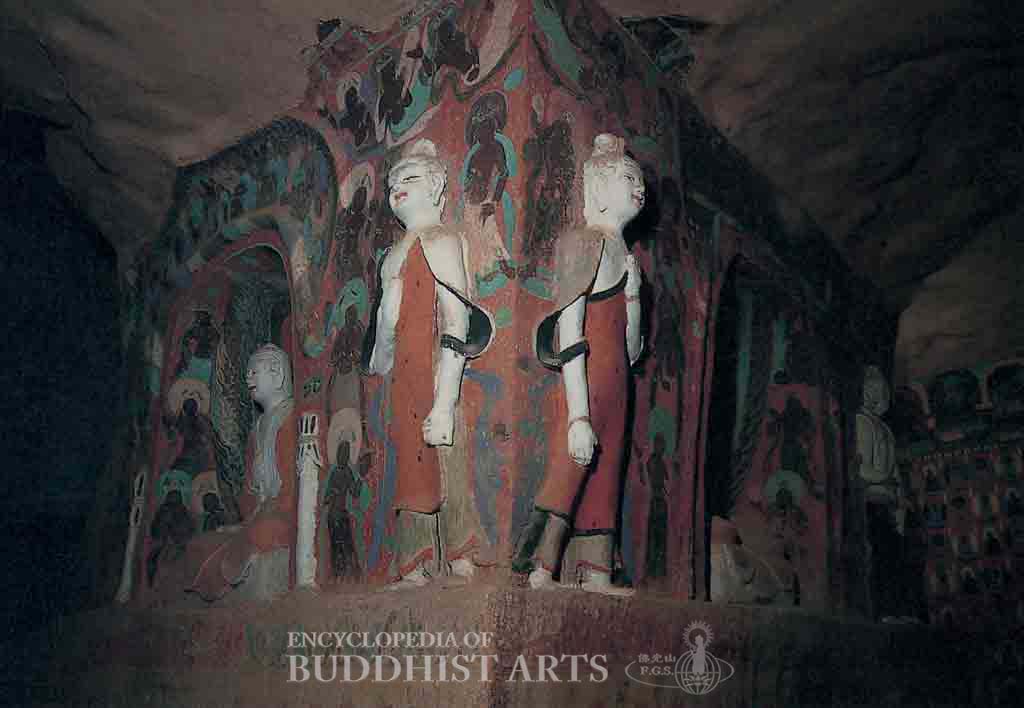
Western Thousand Buddha Cave 7: Central Pillar (east and north sides)
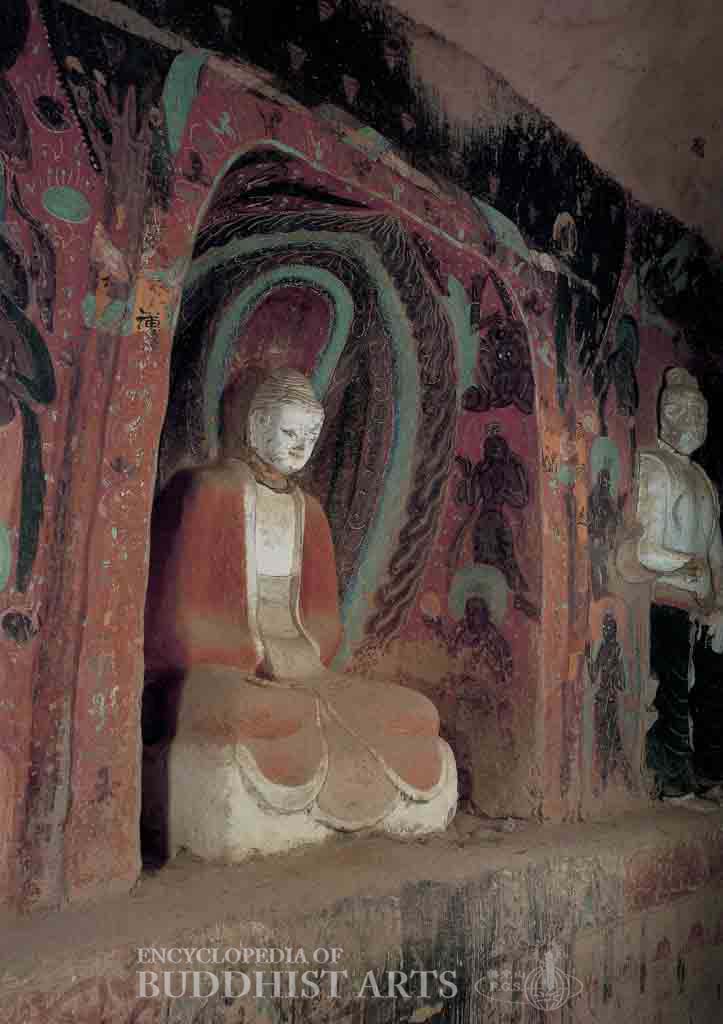
Western Thousand Buddha Cave 7: Central Pillar (north side)
Western Thousand Buddha Cave 7
CHINA, Gansu, Dunhuang
This cave is located in the western area of the cave system. It faces south, and was constructed during the late Northern Wei dynasty (386–534). The front portion of the cave has collapsed, and the back portion contains a central pillar and remnants of the flat ceiling.
Each side of the central pillar is carved with a niche and contains a painted statue of a seated Buddha. A standing Bodhisattva is found on both sides of each niche. Significant repairs were made to these statues during the Qing dynasty (1644–1911). Painted within and around the niches are Bodhisattvas that either stand in a graceful posture or kneel with palms joined. The statue in the south side niche is the only carving in the Western Thousand Buddha Caves that was created during the Northern Wei dynasty and has not been modified or repaired. The niche on the north side is also somewhat unique: it has painted trees on either side of the niche opening, with the trunks carved in relief, which gives them a three-dimensional effect. Each side of the pillar’s base is painted with donor figures that date to the Western Wei dynasty (535–556). These figures’ heads have become blurred, but the style of the costume is still distinguishable.
Painted at the tops of the cave walls are heavenly beings with the Thousand Buddhas motif below them, while yaksas are painted at the bottom of each wall.
For more details, go to the Encyclopedia of Buddhist Arts: Caves T-Z, page 1495.
Cite this article:
author = Hsingyun and Youheng and Johnson, Peter and Mankuang and Huntington, Susan and Edson, Gary and Neather, Robert,
booktitle = {Encyclopedia of Buddhist Arts: Caves T-Z},
pages = 1495,
title = {{Western Thousand Buddha Cave 7}},
volume = 9,
year = {2016}}