
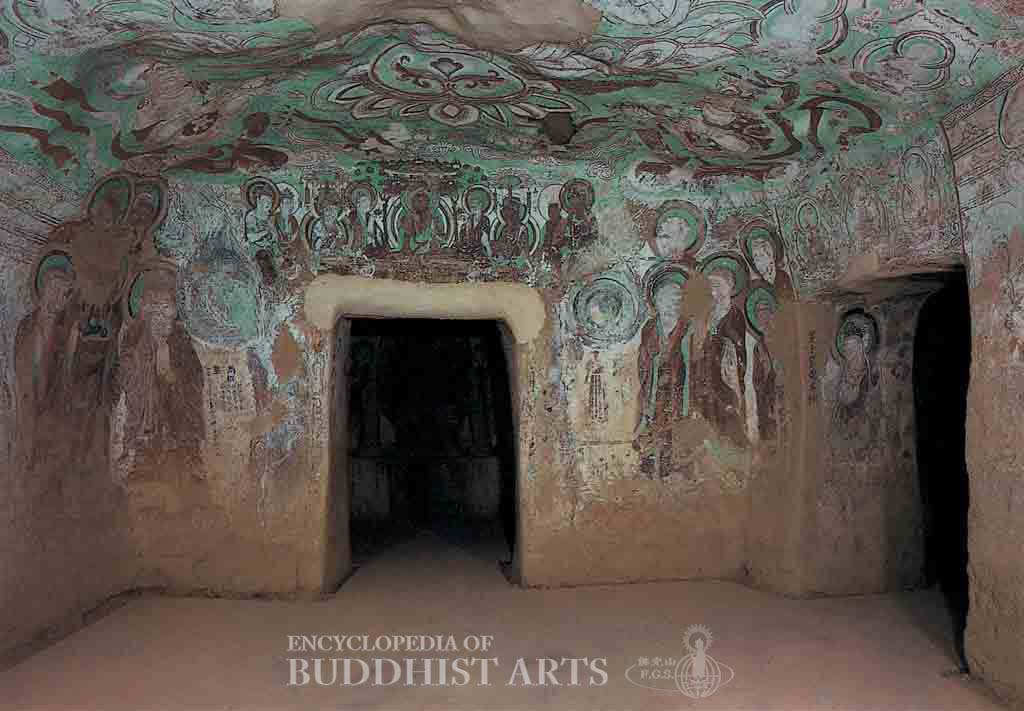
Western Thousand Buddha Cave 4: Front Chamber
Western Thousand Buddha Cave 4
CHINA, Gansu, Dunhuang
This cave is situated in the western area of the cave system. It was built during the Sui dynasty (581–618), with repairs made during the Tang dynasty (618–907), the Uighur period (9th century–1209), and after year 1911. The cave consists of a front chamber and a rear chamber..
The front chamber has a slightly arched ceiling and two doorways. The doorway on the east wall leads to Cave 5, which was constructed during the Tang dynasty, while the doorway on the back (north) wall leads to the rear chamber. The ceiling of the cave is painted with Buddhas, lotuses, and other designs. The west wall of the cave is painted with Samantabhadra Bodhisattva and four disciples. Paintings of three seated Buddhas, created during the Uighur period, are depicted above the east wall doorway and on either side are illustrations of Manjusri Bodhisattva and disciples.
A well-preserved mural of the Buddha teaching the Dharma is found above the entrance on the back wall. It depicts nine figures in total: the Buddha in the center, flanked by alternating figures of disciples and Bodhisattvas. The Buddha sits in full lotus position and wears a green monastic robe. A large, ornate canopy is depicted above the Buddha’s head. A Bodhi tree stands on each side of the Buddha’s throne, and behind the Buddha is a nimbus and a large round mandorla. The paintings on both side of the doorway were repainted numerous times, with portraits of donor figures that date to the Sui dynasty, a fragment of a nimbus painted in the Tang dynasty, and repainted disciples, figures making offerings, and a nimbus, that date to the Uighur period. The faces and details of these images are now indistinct.
The corridor leading to the rear chamber is painted with Medicine Buddha and a Bodhisattva on each side wall. A niche carved into the back wall contains a Buddha statue which was re-sculpted after 1911. The side walls contain illustrations of the Buddha Teaching the Dharma, while apsaras are depicted on the upper register of all four walls. An inscription in red color is written above the doorway on the front (south) wall.
For more details, go to the Encyclopedia of Buddhist Arts: Caves T-Z, page 1493.
Cite this article:
author = Hsingyun and Youheng and Johnson, Peter and Mankuang and Huntington, Susan and Edson, Gary and Neather, Robert,
booktitle = {Encyclopedia of Buddhist Arts: Caves T-Z},
pages = 1493,
title = {{Western Thousand Buddha Cave 4}},
volume = 9,
year = {2016}}