
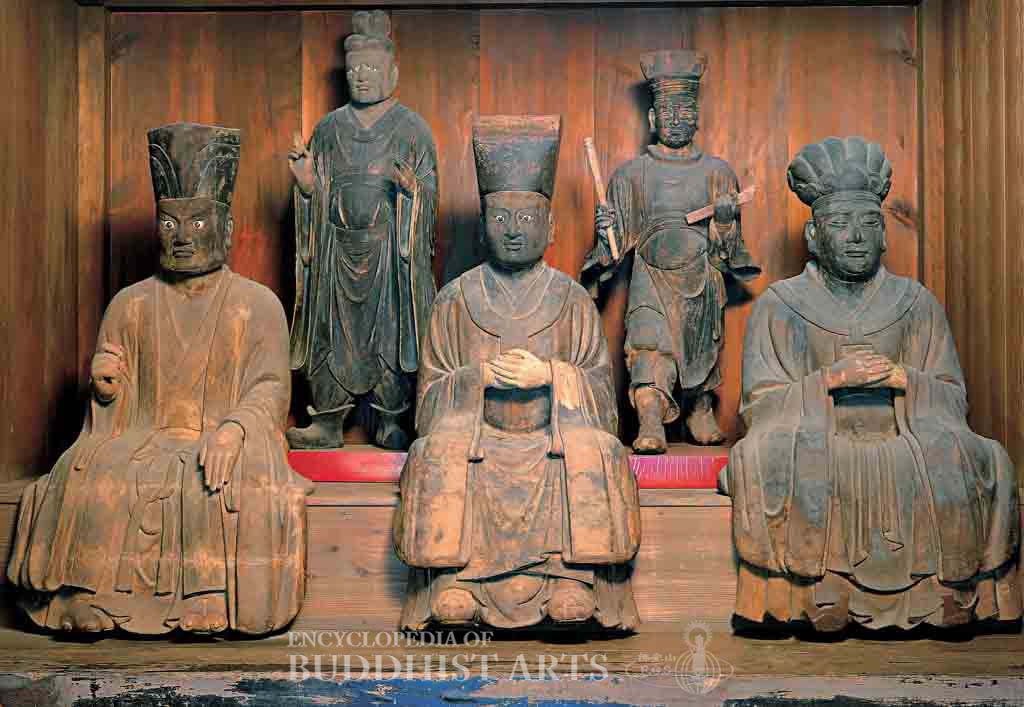
Kenchoji Temple Buddha Hall: Sangharama Bodhisattvas
Wood
Kenchoji Temple Buddha Hall: Sangharama Bodhisattvas
JAPAN, Kanagawa, Kamakura; Kamakura period
These sculptures are the earliest surviving statues of the Sangharama in Japan. They date from the end of the 13th century to the first half of the 14th century. Kenchoji Temple was modeled upon a Song Buddhist temple at a time of religious syncretism. Therefore, these temple guardians became popular in China and were accepted by Buddhism as Dharma protectors.
Of the five, only one figure has his hair tied up in a topknot. The others wear hats adapted from the headgear of Chinese officials. They wear wide-sleeved gowns secured with belts. Those seated at the front wear turned-up shoes while those at the back stand in boots. Some of the figures have hands clasped, while others are gesticulating. The figure striding forward at the back carries instruments of office.
For more details, go to the Encyclopedia of Buddhist Arts: Sculpture G-M, page 529.
Cite this article:
author = Hsingyun and Youheng and Lovelock, Yann and Chou, Yuan and Huntington, Susan and Edson, Gary and Neather, Robert,
booktitle = {Encyclopedia of Buddhist Arts: Sculpture G-M},
pages = 529,
title = {{Kenchoji Temple Buddha Hall: Sangharama Bodhisattvas}},
volume = 11,
year = {2016}}