
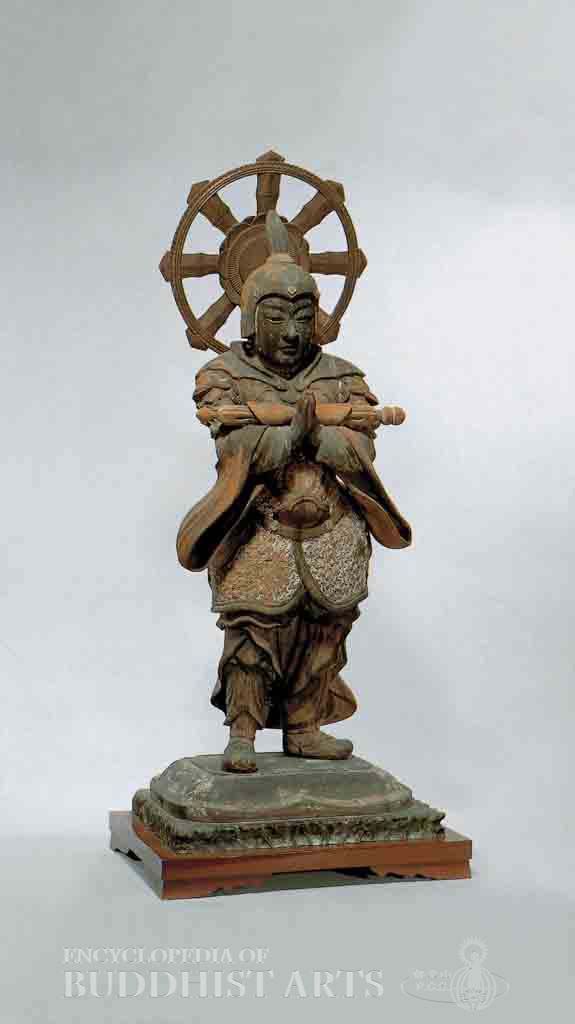
Jochiji Temple: Skanda
Wood
Jochiji Temple: Skanda
JAPAN, Kanagawa, Kamakura; Nanbokucho period
The statue is created from mixed media and dates from the Nanbokucho period (1336–1392). The eyes are inset with semi-precious stone and the details have been molded in clay on a carved wooden body. The helmeted head is backed by a Dharma wheel nimbus with a lotus flower hub and sword blades for spokes, in keeping with Skanda’s function as a Dharma protector. The figure stands in full armor with hands in anjali (reverence) mudra, cradling a thunderbolt. A wide sleeved tunic is worn over a breastplate and a divided skirt falls to flutter around booted feet. The pattern on the clothing has been molded in clay, a technique often seen during the late Kamakura period (1185–1333) and was carried into the early Muromachi period (1392–1573).
For more details, go to the Encyclopedia of Buddhist Arts: Sculpture G-M, page 502.
Cite this article:
author = Hsingyun and Youheng and Lovelock, Yann and Chou, Yuan and Huntington, Susan and Edson, Gary and Neather, Robert,
booktitle = {Encyclopedia of Buddhist Arts: Sculpture G-M},
pages = 502,
title = {{Jochiji Temple: Skanda}},
volume = 11,
year = {2016}}