
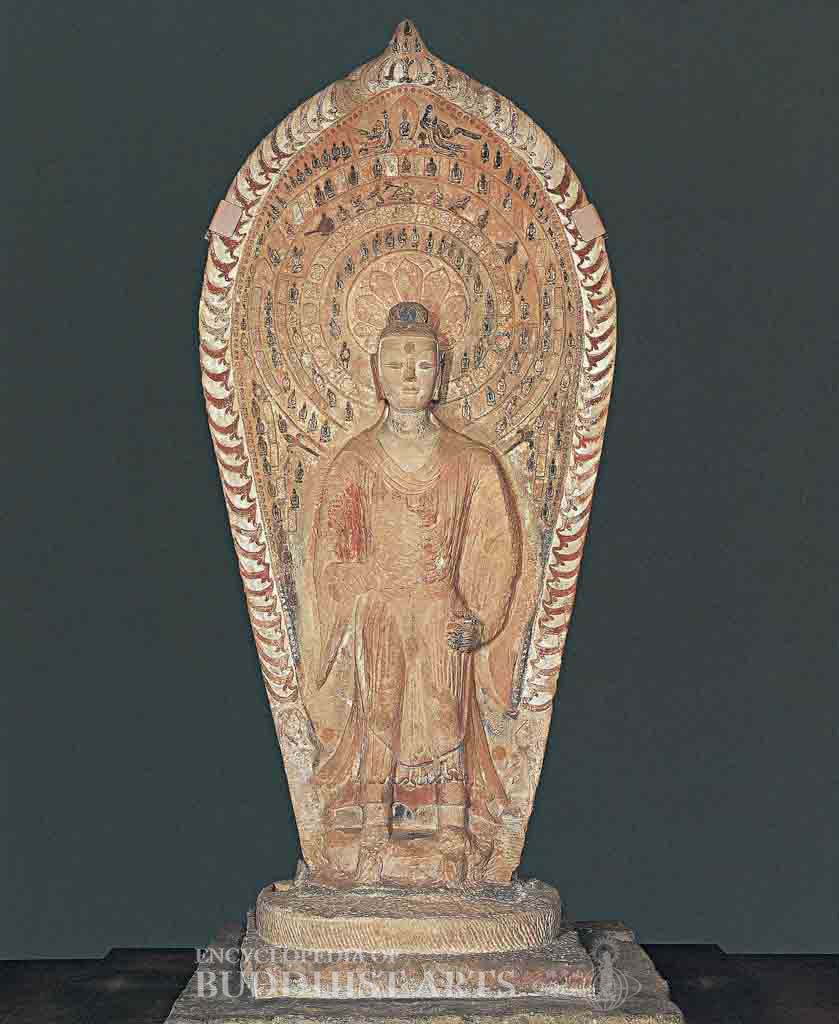
Standing Buddha
Stone
Standing Buddha
CHINA; Northern Wei dynasty
This work from late 5th century is one of the largest Chinese sculptures kept in Japan and probably originates from Dongchan Temple in Zhuozhou, Hebei. The style of the figure is primitive and simple. The monastic robe covers both shoulders and clings about the legs but also fans out below the arms and the thighs. A lotus is at the center of the nimbus, around which are successive, radiations decorated with seated Buddhas, apsaras scattering flowers, lions, donors, and heavenly musicians as well as dancers. The reverse is as ornate and is inscribed with the names of dozens of donors of the Huan clan. The work is listed as an Important Cultural Property of Japan.
For more details, go to the Encyclopedia of Buddhist Arts: Sculpture St-Z, page 1133.
Cite this article:
author = Hsingyun and Youheng and Lovelock, Yann and Chou, Yuan and Huntington, Susan and Edson, Gary and Neather, Robert,
booktitle = {Encyclopedia of Buddhist Arts: Sculpture St-Z},
pages = 1133,
title = {{Standing Buddha}},
volume = 13,
year = {2016}}