
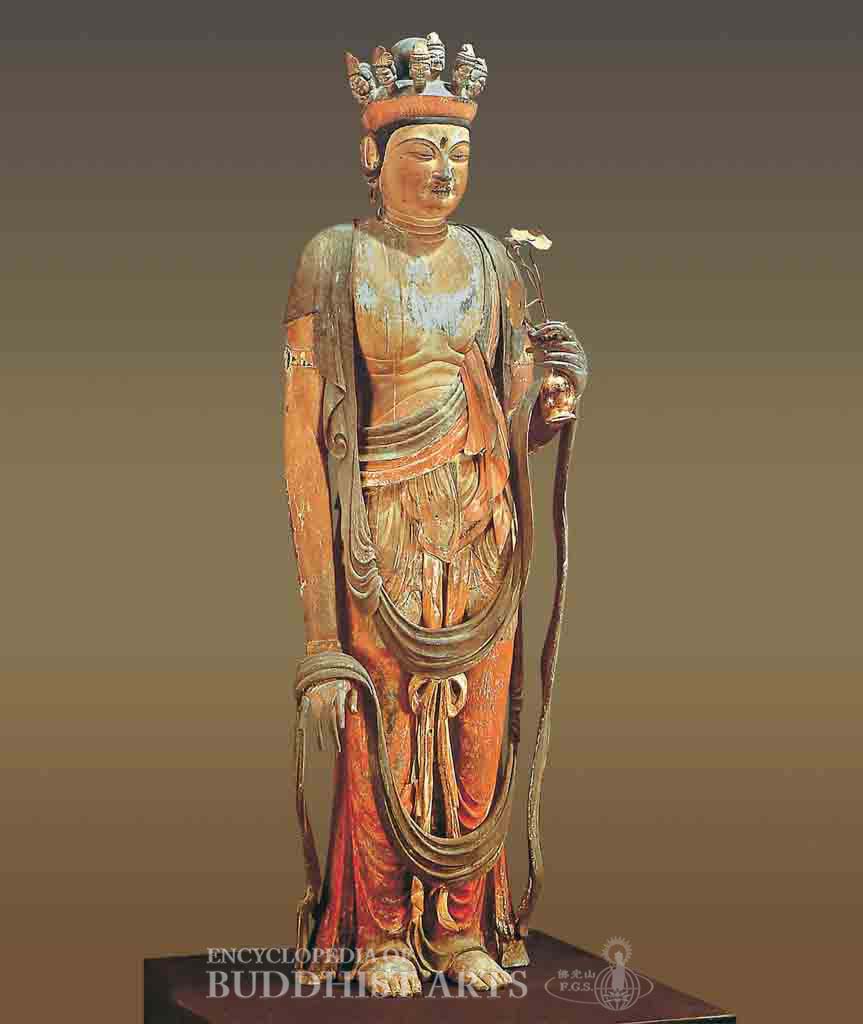
Hagaji Temple Main Hall: Eleven-Headed Avalokitesvara
Cypress wood
Hagaji Temple Main Hall: Eleven-Headed Avalokitesvara
JAPAN, Fukui, Obama; Heian period
The statue is the focus of the temple’s main hall. Most of the figure was carved from a single block of cypress wood, with later additions, and the interior has been hollowed. The silk cape, the lower part of the skirt, and some other areas have been painted on the fold lines to give the drapery a three-dimensional effect. The statue shows strong artistic influence of the late Nara (710–1185) and early Heian (794–1185) periods, and is estimated to date from the latter half of the 9th century. It was listed as an Important Cultural Property in 1994.
The Bodhisattva wears a crown bearing the other heads. The lack of a Buddha face above, or of any ornamentation, is a distinctive feature of this statue. The three lines on the neck signify a great person. The left hand holds a vase with a lotus, while the excessively long right arm reaches below the knee. The elegant skirt almost covers the bare feet, while a stole falls from the shoulders and arms as it loops to the ground. The paint on the figure has been preserved well, with the crown colored cinnamon, the eyebrows and eyes black, the chest beige, and the gown bright vermilion.
For more details, go to the Encyclopedia of Buddhist Arts: Sculpture G-M, page 410.
Cite this article:
author = Hsingyun and Youheng and Lovelock, Yann and Chou, Yuan and Huntington, Susan and Edson, Gary and Neather, Robert,
booktitle = {Encyclopedia of Buddhist Arts: Sculpture G-M},
pages = 410,
title = {{Hagaji Temple Main Hall: Eleven-Headed Avalokitesvara}},
volume = 11,
year = {2016}}