
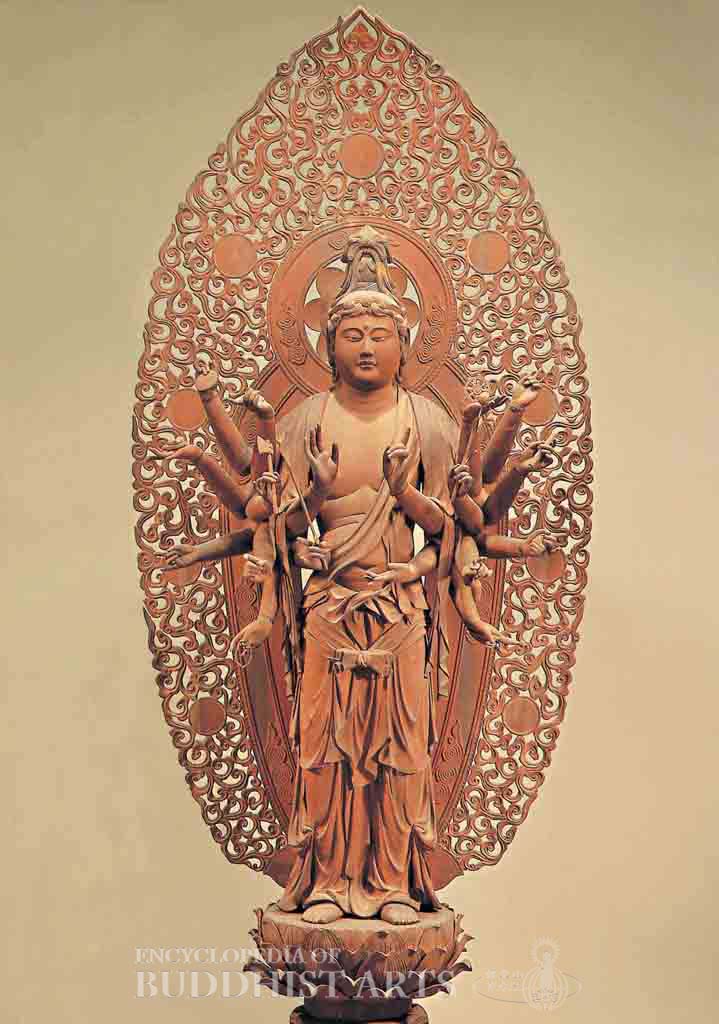
Daihoonji Temple: Cundi
Cypress wood
Daihoonji Temple: Cundi
JAPAN, Kyoto; Kamakura period
Cundi is the eighteen-armed form of Avalokitesvara in Shingon Buddhism. A copy of the Cundi Dharani Sutra was discovered inside the statue. The figure was carved by the sculptor Higo Jokei and dedicated in 1224 according to an ink inscription. The statue was originally kept in the Kitano Tenmangu Shrine, but was moved to the current location during the Edo period (1615–1868). It is listed as an Important Cultural Property.
The figure has seven pairs of arms that at one time held various Dharma instruments. The two remaining pairs of hands are held before the body, with the top pair making the abhaya (fearlessness) and karana (warding off evil) mudras. The figure’s hair is tied in an elaborate topknot and the facial features are open and benevolent. The eyes are inlaid with semi-precious stone. Stoles drape about the shoulders and arms, and the skirt falls in complex folds to the lotus pedestal. An ornate openwork mandorla encloses an aureole and nimbus. Experts believe the sculpture was influenced by the Chinese Song (960–1279) style.
For more details, go to the Encyclopedia of Buddhist Arts: Sculpture A-F, page 277.
Cite this article:
author = Hsingyun and Youheng and Lovelock, Yann and Chou, Yuan and Huntington, Susan and Edson, Gary and Neather, Robert,
booktitle = {Encyclopedia of Buddhist Arts: Sculpture A-F},
pages = 277,
title = {{Daihoonji Temple: Cundi}},
volume = 10,
year = {2016}}