
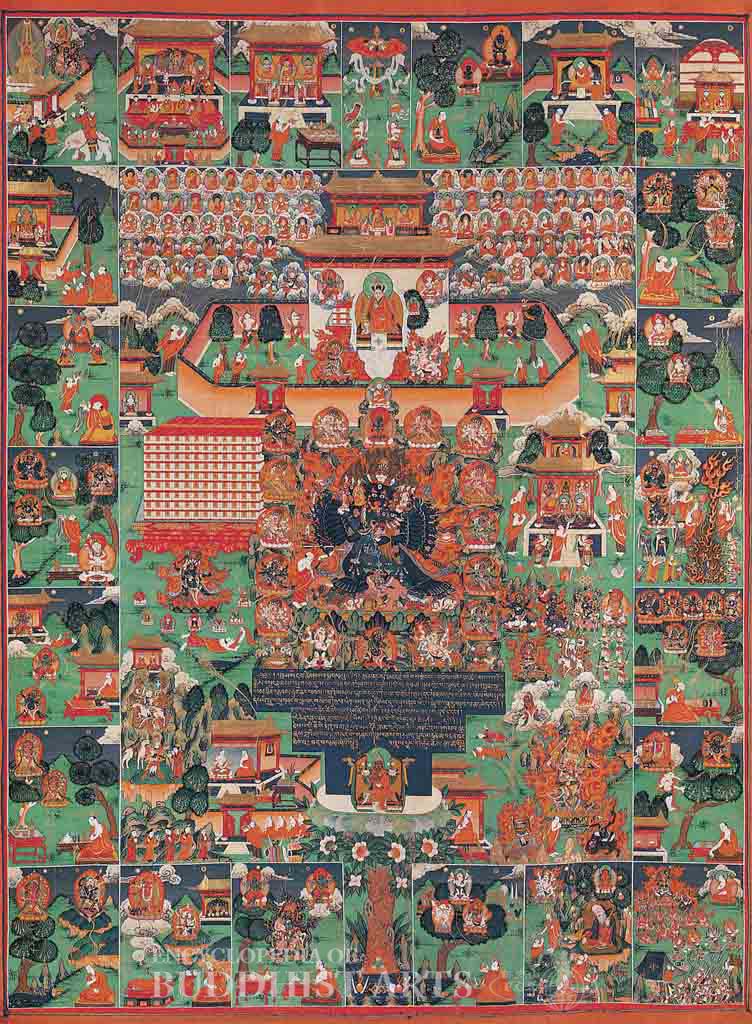
Biography of Bogd Khan
Ink and color on cotton

Biography of Bogd Khan
Biography of Bogd Khan
MONGOLIA
There is an inscription attached to the lining on the back of this thangka identifying it as the biography of Bogd Khan. He was the Eighth Jebtsundamba or Bogdo Gegen, part of a lineage of living Buddhas of the Gelug school that began in the early 17th century. Together with the Changkya Khutuktu lineage, it is one of the longest traditional lineages in Mongolia. The thangka is a visual hagiography that portrays the spiritual achievements of the previous incarnations of the Jebtsundamba and maps the relationships between the living Buddhas and Dharma protectors. Some of the most significant events in the history of Mongolian Buddhism are symbolically depicted.
The thangka is divided into inner and outer squares. Yamantaka and his consort are shown in the middle, surrounded by Dharma protectors. Above Yamantaka, Zanabazar, the first to bear the title of Bogdo Gegen, sits within a palace-shrine. Beside Zanabazar on the right and left are White and Green Tara. Below Zanabazar, there are images of Begtse, the protector of the Bogdo Gegens and Dalai Lamas, and the white, lion-riding Pehar, the guardian of monasteries. The second story of the palace-shrine is occupied by the Buddhas of the Past, Present, and Future. Below the central Yamantaka, seated against a dark blue backdrop inscribed with a long prayer in Tibetan, is the Eighth Jebtsundamba. On the left there is an illustration of the Jebtsundamba sitting beside Manjusri Bodhisattva within a pavilion. This symbolizes the Jebtsundamba lineage’s connection with the Gelug school, for the founder of the Gelug school, Tsongkhapa, was an incarnation of Manjusri.
The thangka is bordered by rectangles that each contain a scene from the lives of the Jebtsundamba. In the upper left corner, the Jebtsundamba and his father are shown riding to a pagoda guarded by Lhamo, the chief protectress of the Gelug school. Immediately to the right, an elaborate ceremony is portrayed. Next, the Jebtsundamba is shown receiving an empowerment from the Buddhas of the Past, Present, and Future. Then he is shown contemplating the figure of Vajradhara, shown first with his consort, then alone, and finally as an image that the Jebtsundamba cradles in his arms. In the next square, the Jebtsundamba listens to the Fifth Dalai Lama teach the Dharma. In the upper right corner, the Jebtsundamba bestows blessings on Emperor Kangxi (reigned 1661–1722) of the Qing dynasty and his mother. Additional scenes depict how the Jebtsundamba is endowed with the power of many Dharma protectors. One scene depicts the Third Dalai Lama and Altan Khan (reigned 1531–1582) presiding over a ritual. Another scene shows the Jebtsundamba taming Tibet’s indigenous deities and converting them to Buddhism, and receiving an endowment of power from Maitreya Bodhisattva.
For more details, go to the Encyclopedia of Buddhist Arts: Painting A-H, page 105.
Cite this article:
author = Hsingyun and Youheng and Youlu and Wilson, Graham and Manho and Mankuang and Huntington, Susan,
booktitle = {Encyclopedia of Buddhist Arts: Painting A-H},
pages = 105,
title = {{Biography of Bogd Khan}},
volume = 14,
year = {2016}}