
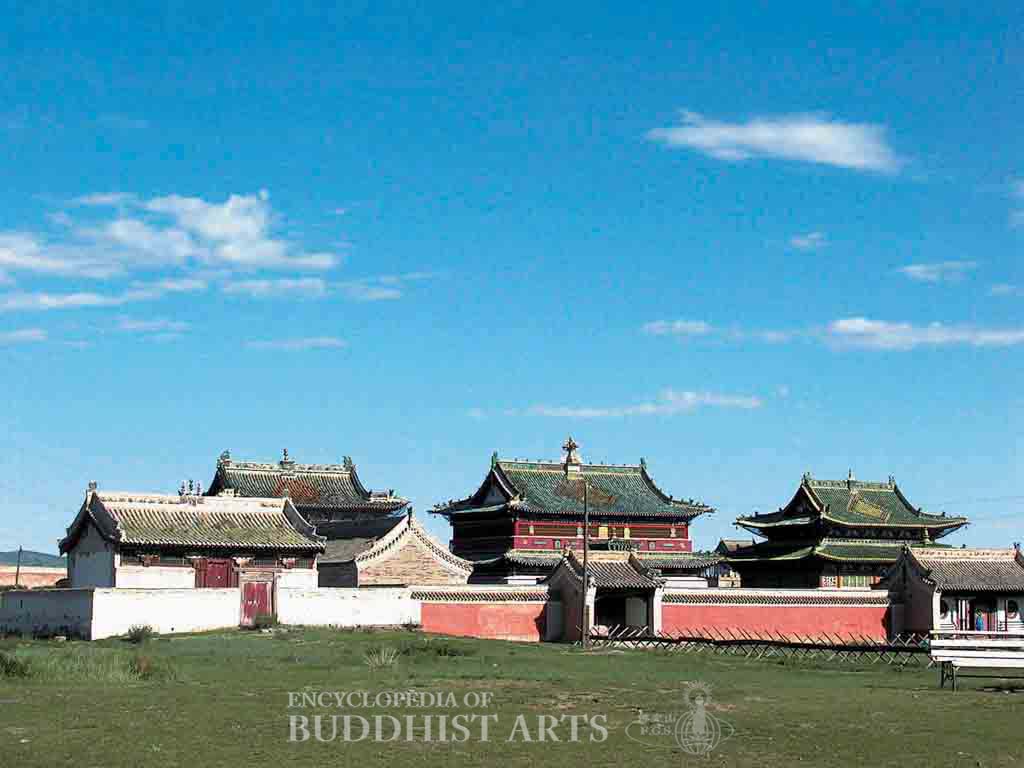
Erdene Zuu Monastery

Erdene Zuu Monastery: White Stupas

Erdene Zuu Monastery: Stupa
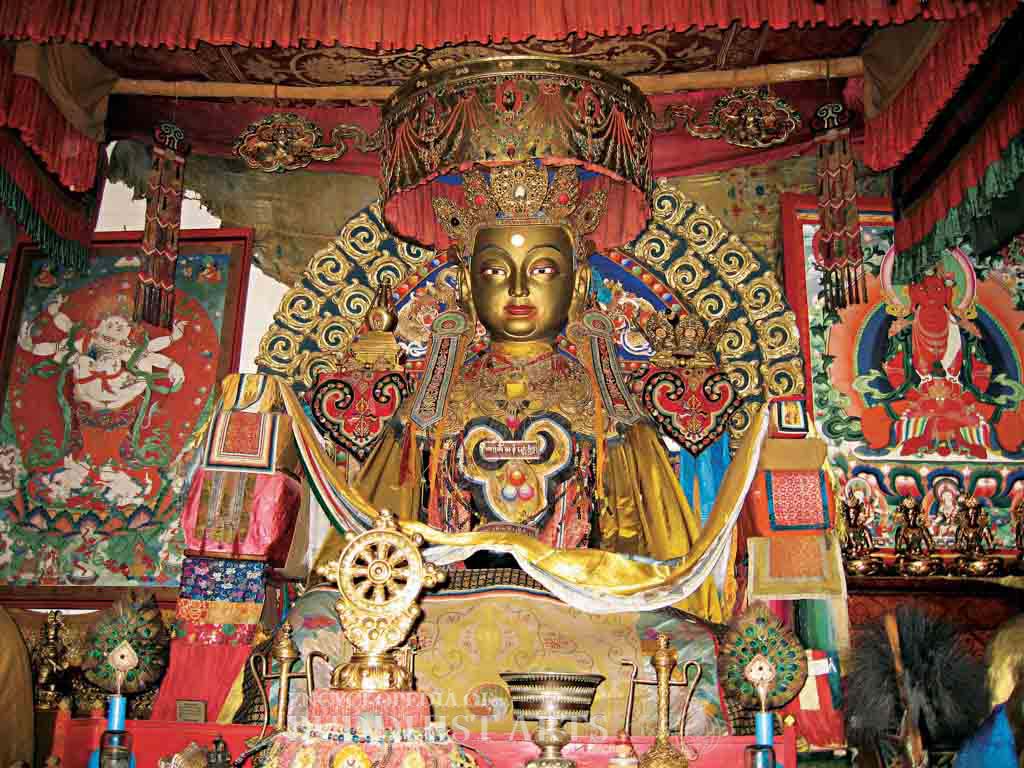
Erdene Zuu Monastery: Sakyamuni Buddha
Erdene Zuu Monastery
MONGOLIA, Uvurkhangai, Kharkhorin
Erdene Zuu means Hundred Treasures. It was the first Buddhist monastery in Mongolia and belongs to the Gelug school of Tibetan Buddhism. Construction of the monastery was initiated by Abtai Sain Khan in 1586. It was destroyed during wartime in 1688 and was rebuilt in the 18th century. It peaked from 1862 to 1874, when it had over 60 temples within its compound and over 1,000 resident monks. The monastery was destroyed during the religious persecution of the late 1930s, apart from three small temples. Many valuable artifacts, including paintings and sutras from the 15th to 17th centuries, were also destroyed, although some statues, tsam masks and thangkas were hidden and saved. In 1965 the site was opened as a museum. After 1990 and the restoration of religious freedom, it became a monastery once again and monks came to reside there. As part of the Orkhon Valley Cultural Landscape, the monastery was listed as a UNESCO World Heritage Site in 2004.
The monastery occupies 16 ha and the square compound is surrounded by a stone boundary wall featuring 108 white stupas placed approximately 15 m part. There is a doorway in the middle of each boundary wall. Most of the structures are built in brick in a fusion of Mongolian, Tibetan, and Chinese styles. There are three temples which house statues of Sakyamuni Buddha in three stages of life: childhood, adolescence, and adulthood. The Baruun Zuu, the temple to the west, is dedicated to the adult Buddha. The Zuu of Buddha, the central temple, houses a statue depicting the Buddha as a child. The Zuun Zuu, the temple to the east, contains the adolescent Buddha. There are other buildings such as the Dalai Lama Sum, Golden Prayer Stupa, and Lavrin Sum.
For more details, go to the Encyclopedia of Buddhist Arts: Architecture A-F, page 276.
Cite this article:
author = Hsingyun and Youheng and Johnson, Peter and Mankuang and Lancaster, Lewis,
booktitle = {Encyclopedia of Buddhist Arts: Architecture A-F},
pages = 276,
title = {{Erdene Zuu Monastery}},
volume = 1,
year = {2016}}