
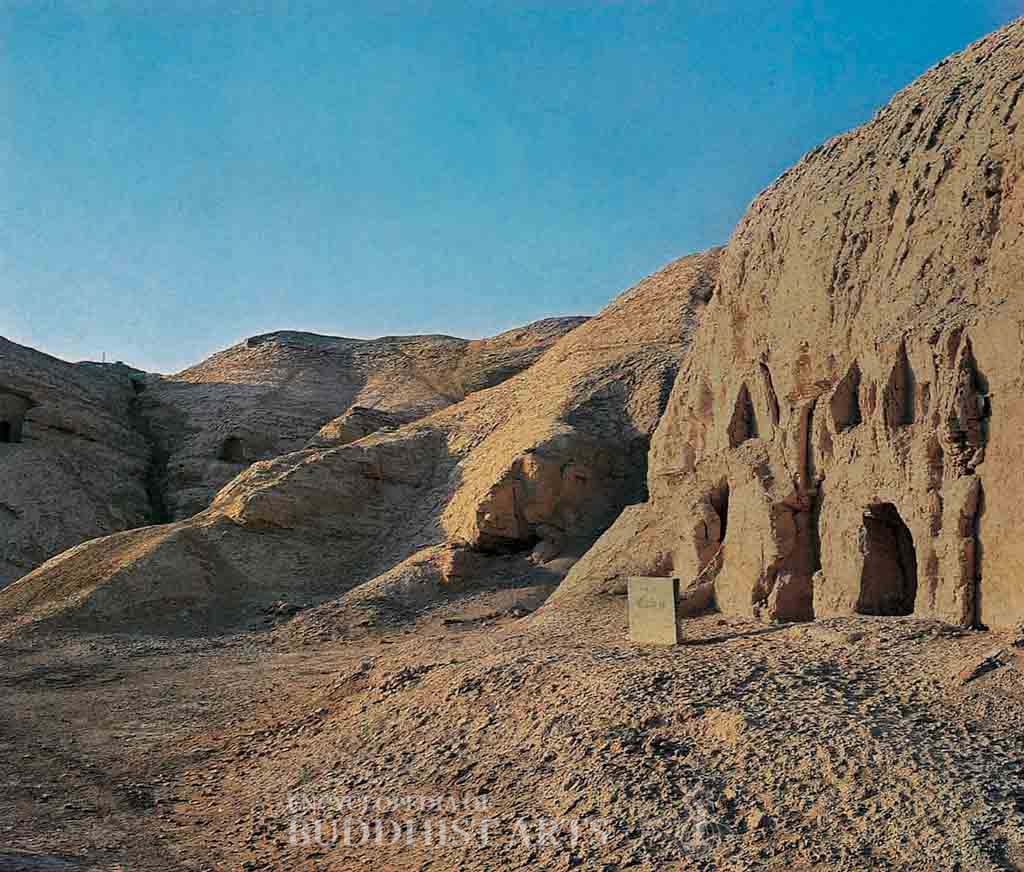
Qigxin Caves
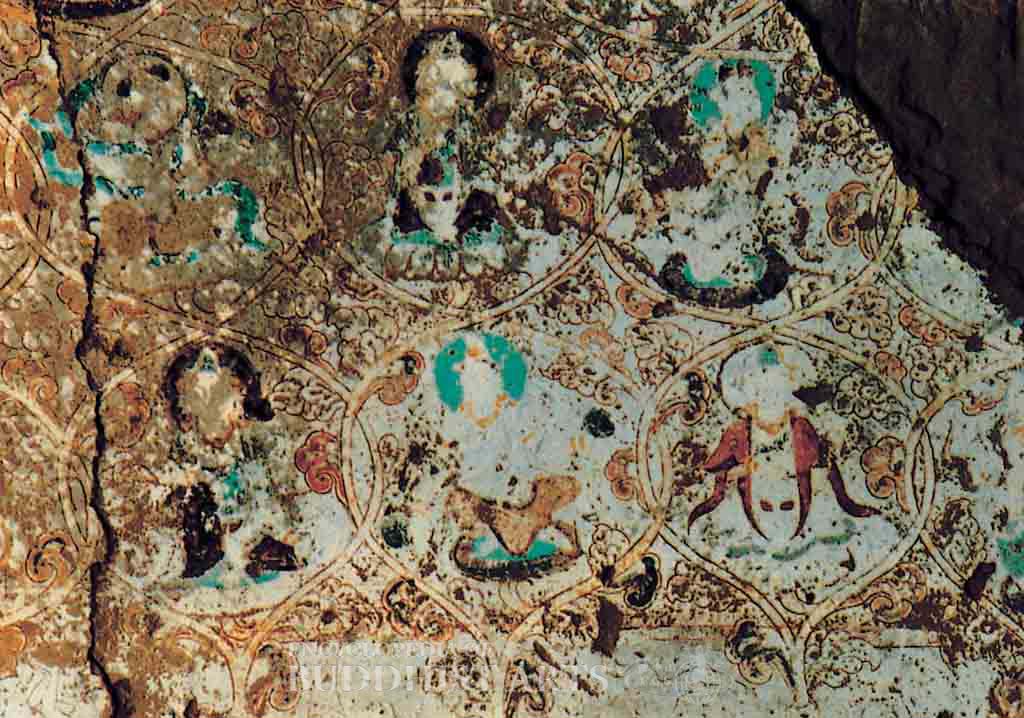
Qigxin Caves: Cave 4 - Ceiling
Qigxin Caves
CHINA, Xinjiang, Bayingolin
Located on the slopes of Horo Shan, the Qigxin Caves are approximately 30 km southwest of Yanqi, and 2 km northwest of the temple ruins at Qigxin. Construction of the caves began in the 4th to 5th century and continued into the 10th century. Qigxin was a significant hub along the northern route of the Silk Road, and a connection point between the Kucha and Gaochang Buddhist sites. The ten caves discovered at the site reflect these influences. As part of the site of Qigxin, these caves were listed as a National Cultural Heritage Site in 2001.
The site contains three types of caves: central pillar caves, small statue caves, and meditation caves. Most are central pillar caves, with an antechamber, a main chamber, and corridors that form the central pillar. The antechambers of most of these structures have collapsed. The main chambers are rectangular with barrel-vaulted ceilings and lack the Buddha niches normally found within the central pillar caves. Instead, most have low platforms which at one time held Buddha statues. The right and left corridors are relatively short, and the rear corridors contain parinirvana scenes. The small statue caves consist of an antechamber and a main chamber; many of which are in ruins. One meditation cave exists, which is rectangular with a barrel-vaulted ceiling. There is one cell in the back wall, while each of the side walls have three meditation cells. A mural of a monk in meditation is found within the cave.
The cave murals are not well preserved. In some caves, a small number of heavenly musicians, cloud patterns, and heavenly dancers can still be discerned. In Cave 4, patterns of intertwined branches and vines are visible on the ceiling, together with a Bodhisattva or a lotus-born child. Between the branches and vines are clouds, flowers, and leaves. From the preserved parts of the murals, it is evident that the painting style is similar to that of the Kumtura Caves.
For more details, go to the Encyclopedia of Buddhist Arts: Caves Mo-S, page 1326.
Cite this article:
author = Hsingyun and Youheng and Johnson, Peter and Mankuang and Huntington, Susan and Edson, Gary and Neather, Robert,
booktitle = {Encyclopedia of Buddhist Arts: Caves Mo-S},
pages = 1326,
title = {{Qigxin Caves}},
volume = 8,
year = {2016}}