
Long Hue Temple
Long Hue Temple
VIETNAM, Ho Chi Minh City
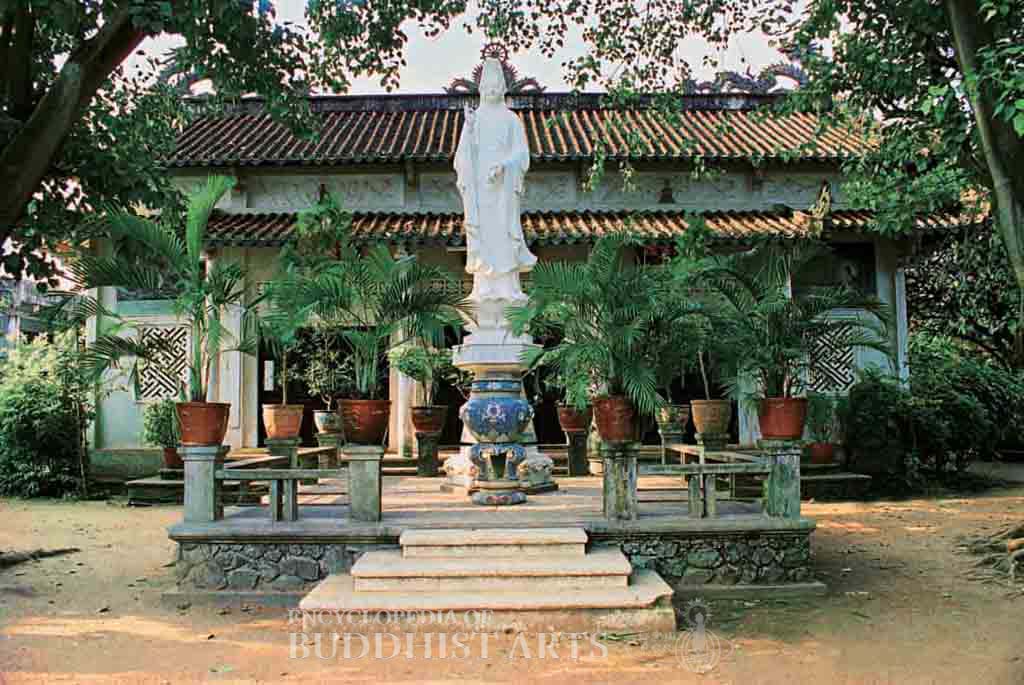
Long Hue means Dragon Flower. It was originally a small hermitage built by the monk Nguyen Quan during the 18th century. The temple underwent large-scale renovation and expansion during the rule of King Nguyen Thanh Thai (reigned 1889–1907). The present-day temple is a result of renovation work undertaken in 1966.
The main hall has a double-eave hip-and-gable roof and is five bays wide. There is a statue of Avalokitesvara Bodhisattva standing in front of the hall. The temple has the original horizontal inscribed board with the name of the temple in Chinese characters bestowed by King Nguyen The To (reigned 1802–1820).
For more details, go to the Encyclopedia of Buddhist Arts: Architecture G-L, page 682.
Cite this article:
Hsingyun, et al. "Long Hue Temple." Encyclopedia of Buddhist Arts: Architecture G-L, vol. 2, 2016, pp. 682.
Hsingyun, Youheng, Peter Johnson, Mankuang and Lewis Lancaster. 2016. "Long Hue Temple" In Encyclopedia of Buddhist Arts: Architecture G-L, 2:682.
Hsingyun, Youheng, Johnson, P., Mankuang, & Lancaster, L. (2016). Long Hue Temple. In Encyclopedia of Buddhist Arts: Architecture G-L (Vol. 2, pp. 682).
@misc{Hsingyun2016,
author = Hsingyun and Youheng and Johnson, Peter and Mankuang and Lancaster, Lewis,
booktitle = {Encyclopedia of Buddhist Arts: Architecture G-L},
pages = 682,
title = {{Long Hue Temple}},
volume = 2,
year = {2016}}
author = Hsingyun and Youheng and Johnson, Peter and Mankuang and Lancaster, Lewis,
booktitle = {Encyclopedia of Buddhist Arts: Architecture G-L},
pages = 682,
title = {{Long Hue Temple}},
volume = 2,
year = {2016}}