
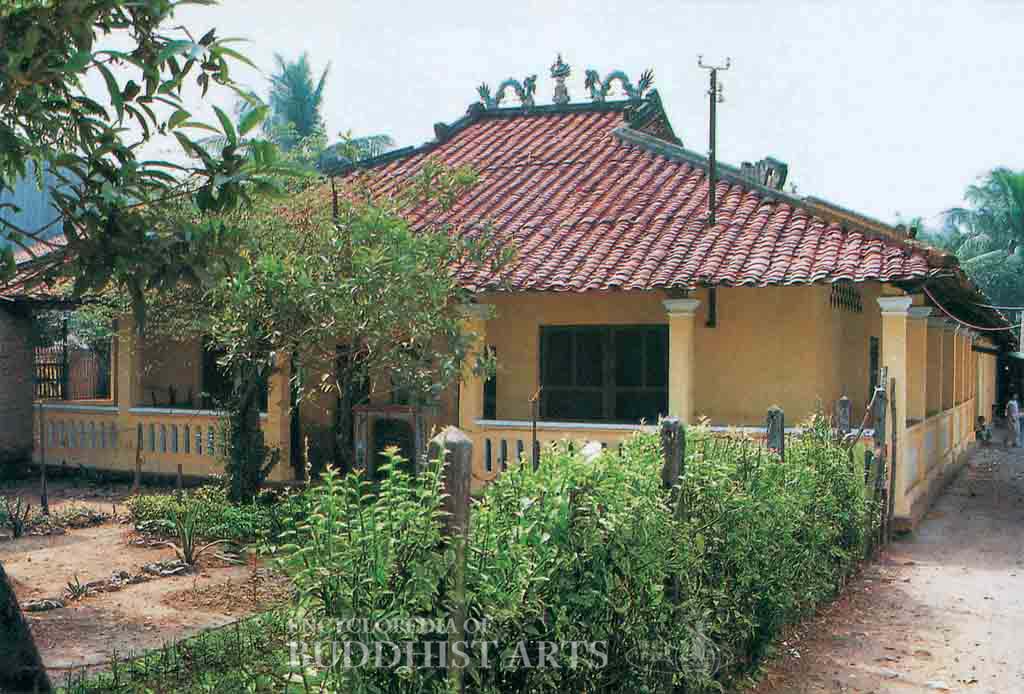
Tu An Temple
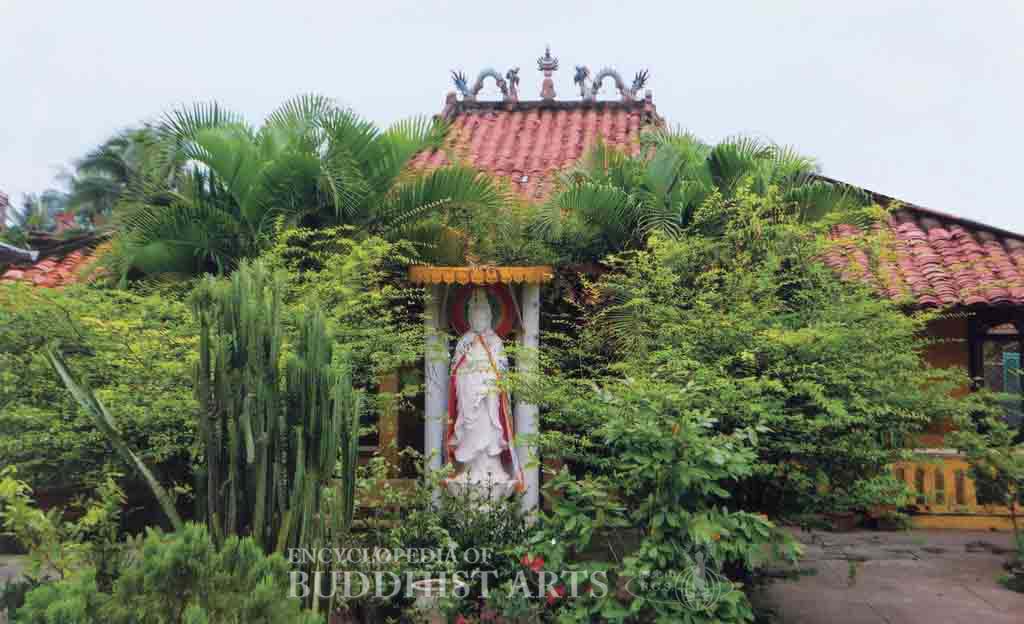
Tu An Temple
Tu An Temple
VIETNAM, Ho Chi Minh City
Tu An means Maternal Grace. Originally it was a small hermitage where the monk Phat Y practiced, but was rebuilt as a temple in 1752 and given its present name. It was rebuilt again in 1802 and later moved to its current location.
The main hall has a hip-and-gable roof with a short central ridge and long hips. The ridge has a pearl in the center with a dragon on either side. The hall is surrounded by a veranda. The temple has a horizontal inscribed board conferred by King Nguyen Thanh To (reigned 1820–1840) with the Chinese characters “Bestowed Upon Maternal Grace Temple by Imperial Order.”
For more details, go to the Encyclopedia of Buddhist Arts: Architecture T-Z, page 1155.
Cite this article:
Hsingyun, et al. "Tu An Temple." Encyclopedia of Buddhist Arts: Architecture T-Z, vol. 4, 2016, pp. 1155.
Hsingyun, Youheng, Peter Johnson, Mankuang and Lewis Lancaster. 2016. "Tu An Temple" In Encyclopedia of Buddhist Arts: Architecture T-Z, 4:1155.
Hsingyun, Youheng, Johnson, P., Mankuang, & Lancaster, L. (2016). Tu An Temple. In Encyclopedia of Buddhist Arts: Architecture T-Z (Vol. 4, pp. 1155).
@misc{Hsingyun2016,
author = Hsingyun and Youheng and Johnson, Peter and Mankuang and Lancaster, Lewis,
booktitle = {Encyclopedia of Buddhist Arts: Architecture T-Z},
pages = 1155,
title = {{Tu An Temple}},
volume = 4,
year = {2016}}
author = Hsingyun and Youheng and Johnson, Peter and Mankuang and Lancaster, Lewis,
booktitle = {Encyclopedia of Buddhist Arts: Architecture T-Z},
pages = 1155,
title = {{Tu An Temple}},
volume = 4,
year = {2016}}