
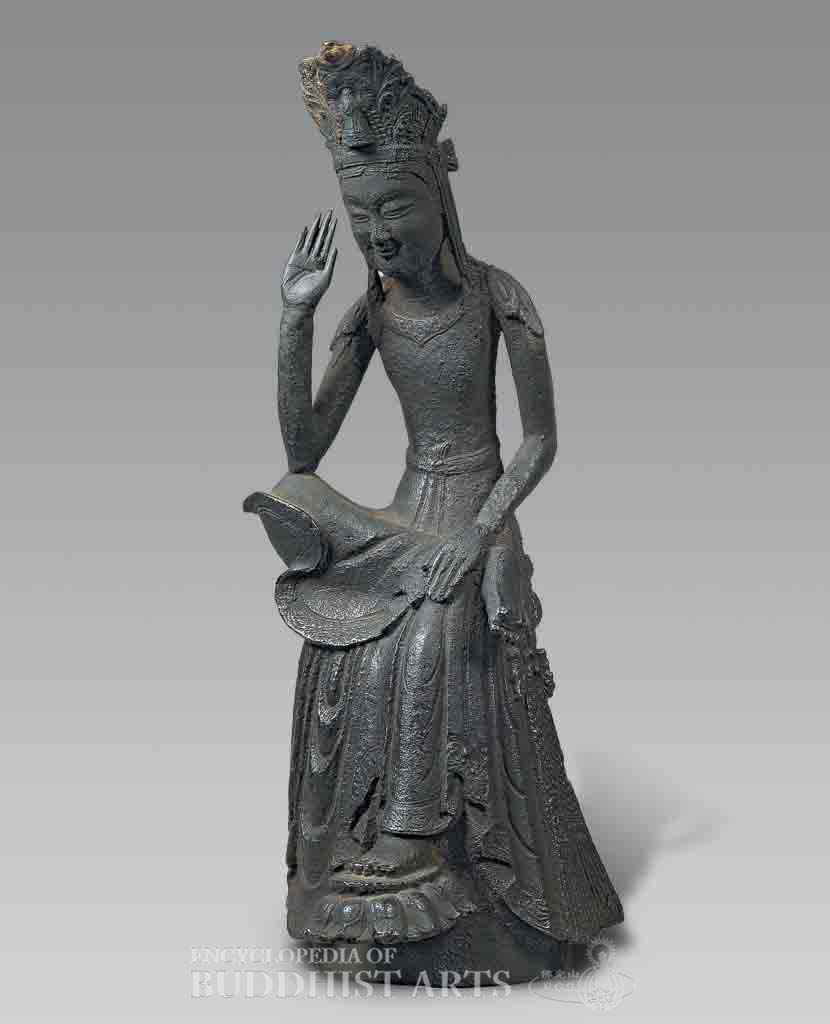
Bodhisattva in Contemplation
Gilt bronze
Bodhisattva in Contemplation
JAPAN; Asuka period
This statue depicts the Bodhisattva sitting on a circular platform in the relaxation posture. The upper body leans forwards and is supported by the knee in the contemplative pose. The statue was cast in one piece, but the right hand was later replaced by one made of wood after being damaged in a fire. This may explain the unusual feature of that hand being held in abhaya (fearlessness) mudra, rather than supporting the head. The statue is listed as an Important Cultural Property.
The Bodhisattva wears a tall and elegant crown that can be linked to the Sassanid Empire (224–651). It has a crescent shaped jewel at the center and tassels hanging down from the sides. The skirt is equally elaborate, with a carefully depicted foliar pattern and a deep hem. It is overhung on the right by a waist jewel that is similar to the type worn in the palace of 6th century China. The overall design of the statue is similar to the Korean Three Kingdoms (57 BCE–668 CE) style, so some believe it was first made in Korea and brought into Japan, or was made by a Korean sculptor living in Japan.
For more details, go to the Encyclopedia of Buddhist Arts: Sculpture A-F, page 169.
Cite this article:
author = Hsingyun and Youheng and Lovelock, Yann and Chou, Yuan and Huntington, Susan and Edson, Gary and Neather, Robert,
booktitle = {Encyclopedia of Buddhist Arts: Sculpture A-F},
pages = 169,
title = {{Bodhisattva in Contemplation}},
volume = 10,
year = {2016}}