
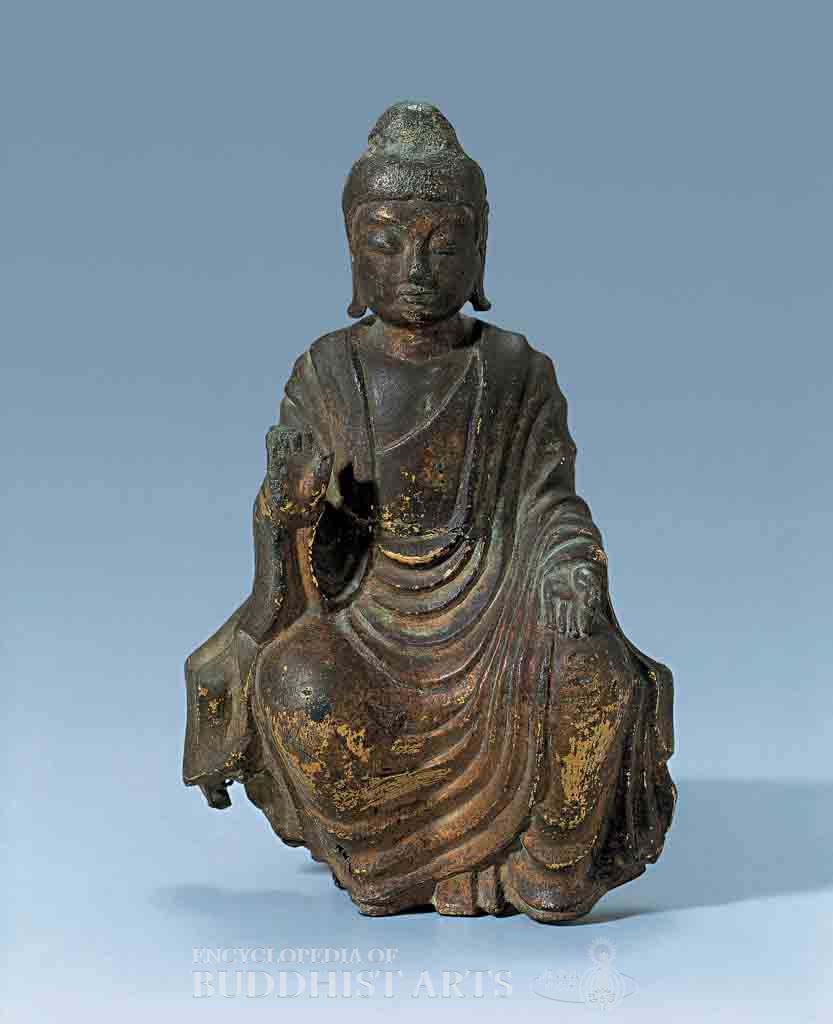
Seated Buddha
Gilt bronze
Seated Buddha
KOREA; Unified Silla dynasty
This sculpture was probably excavated in Mungyeong, North Gyeongsang. The figure sits with legs pendent in a posture usually associated with Maitreya. Though representations of this Buddha carved in stone are common in Korea, the statue is the only surviving example in bronze, and is further evidence of the cultural communication with China at this early date. No bronze statues of this type were discovered from the Goguryeo (37 BCE–668 CE) or Baekje periods (18 BCE–663 CE).
The figure wears a monastic robe covering both shoulders that reveals an inner robe. Its deep folds fall over the edge of the bench on which the figure sits and are molded to show the shape of the legs. Although the fingers of the right hand are damaged, it is likely the figure was forming the abhaya (fearlessness) and varada (wish-granting) mudras.
For more details, go to the Encyclopedia of Buddhist Arts: Sculpture N-Sr, page 1021.
Cite this article:
author = Hsingyun and Youheng and Lovelock, Yann and Chou, Yuan and Huntington, Susan and Edson, Gary and Neather, Robert,
booktitle = {Encyclopedia of Buddhist Arts: Sculpture N-Sr},
pages = 1021,
title = {{Seated Buddha}},
volume = 12,
year = {2016}}