
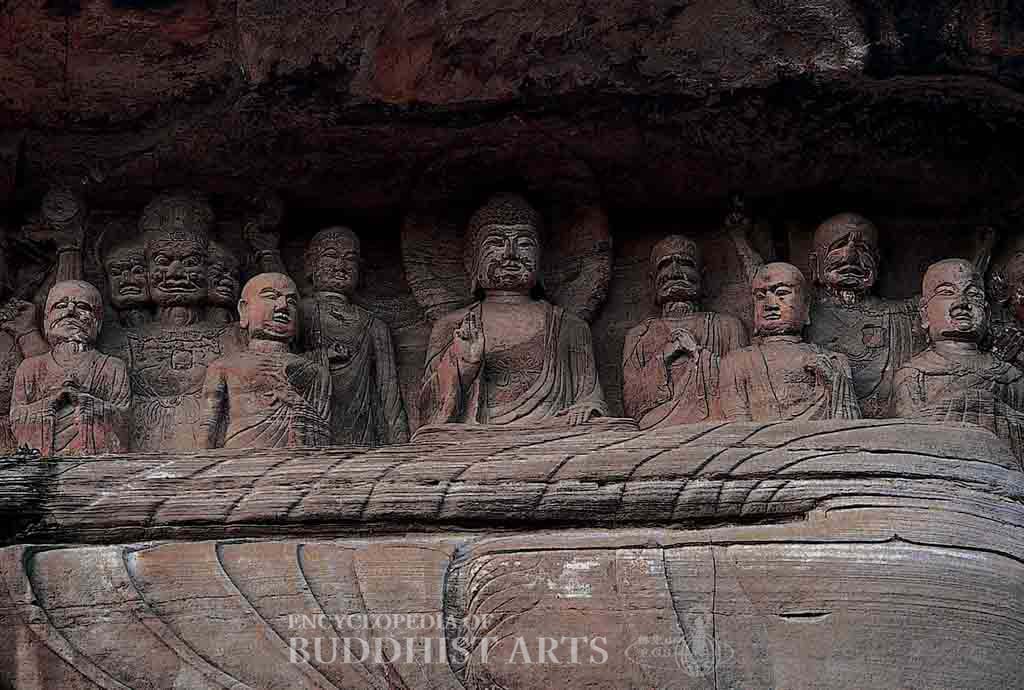
Anyue Wofo Temple Rock Carvings: Niche 3 - Buddha’s Final Teaching (detail)
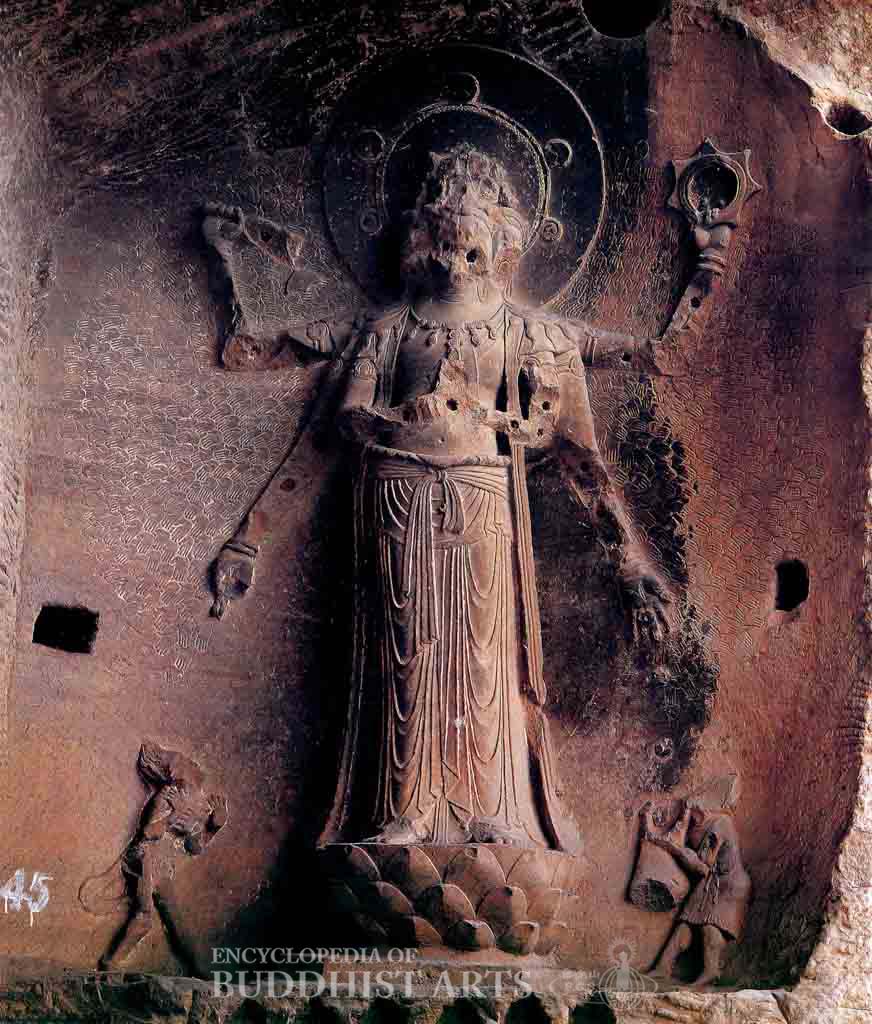
Anyue Wofo Temple Rock Carvings: Niche 45 - Thousand-Armed Avalokitesvara
Anyue Wofo Temple Rock Carvings
CHINA, Sichuan, Ziyang
These carvings are located within Wofo (Reclining Buddha) village in Anyue county. The site derives its name from the large reclining Buddha carved into one of the cliff walls. The carvings run along the north and south cliffs and are distributed along a curved valley in which the widest area is 100 m wide and the tallest cliff face is more than 20 m high. There are currently 139 caves and niches at the site, housing more than 1,600 carvings and numerous inscribed Buddhist texts. Most of the carvings depict either a Buddha, two disciples, two Bodhisattvas, and two warriors; or a Buddha with two Bodhisattvas, surrounded by several attendants. According to the 22 existing inscriptions, the earliest known carving was created in 723 during the Tang dynasty, and the latest in 974 during the Northern Song dynasty. The rest of the inscriptions are mainly records of the maintenance of the caves. It is believed that the sponsors of the carvings were mostly government officials or prestigious citizens of the surrounding towns. The area was listed as a National Cultural Heritage Site in 1988.
Inscribed sutras are the main theme on the south cliff face. Altogether there are 15 caves and niches, with the sutras comprising nearly 130 sq m of space and almost 400,000 characters, 260,000 of which are still decipherable. On the right wall of Cave 46 is the preface to the Tripitaka Catalog by monk Jingtai. Using this catalog, scholars can deduce the content of many of the other sutra carvings, which include the Mahaparinirvana Sutra, Heart Sutra, Lotus Sutra, Sutra on the Names of the Buddhas, and Usnisavijaya Dharani Sutra. Inscribed in regular or running script, the sutra carvings found here are an important source of information for those who wish to study ancient Chinese Buddhist history, scriptural history, and historical calligraphy. The characters are neat and smooth, in a style typical of many Tang dynasty steles. The surviving inscriptions accompanying the sutras date from the years 727, 729, and 735 during the Tang dynasty.
The most famous carving on the north cliff is the 23 m long reclining Buddha in Niche 3. This carving was created during the Tang dynasty (618–907), and is unique due to the fact that Sakyamuni Buddha reclines on his left side, whereas he is typically depicted reclining on the right. It is the only large cliff sculpture in China that portrays the Buddha in this pose. There are also several smaller niches that are particularly interesting. Niche 34, a rectangular 1.4 m long niche, was created during the Tang dynasty. It contains four standing sculptures of Avalokitesvara, Ksitigarbha, Suryaprabha, and Candraprabha Bodhisattvas; a relatively rare combination seen nowhere else at Anyue. Niche 45 contains a 1.35 m high Thousand-Armed Avalokitesvara with eleven heads and six hands. Unfortunately, the main face of the Bodhisattva has been destroyed. Behind the figure, spread out like a fan, are faintly engraved hands representing the thousand arms of Avalokitesvara. Niche 52 contains a relief of a sutra pillar which was carved in 961 of the Five Dynasties.
For more details, go to the Encyclopedia of Buddhist Arts: Caves A-E, page 79.
Cite this article:
author = Hsingyun and Youheng and Johnson, Peter and Mankuang and Huntington, Susan and Edson, Gary and Neather, Robert,
booktitle = {Encyclopedia of Buddhist Arts: Caves A-E},
pages = 79,
title = {{Anyue Wofo Temple Rock Carvings}},
volume = 5,
year = {2016}}