
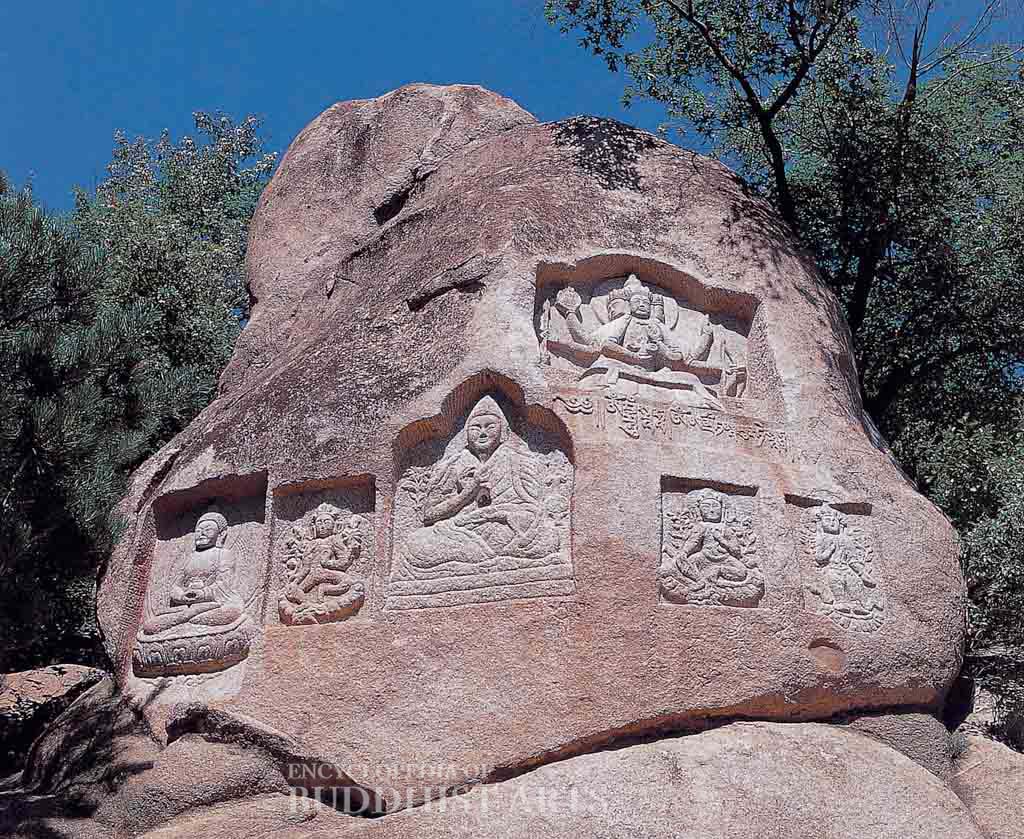
Haitangshan Rock Carvings
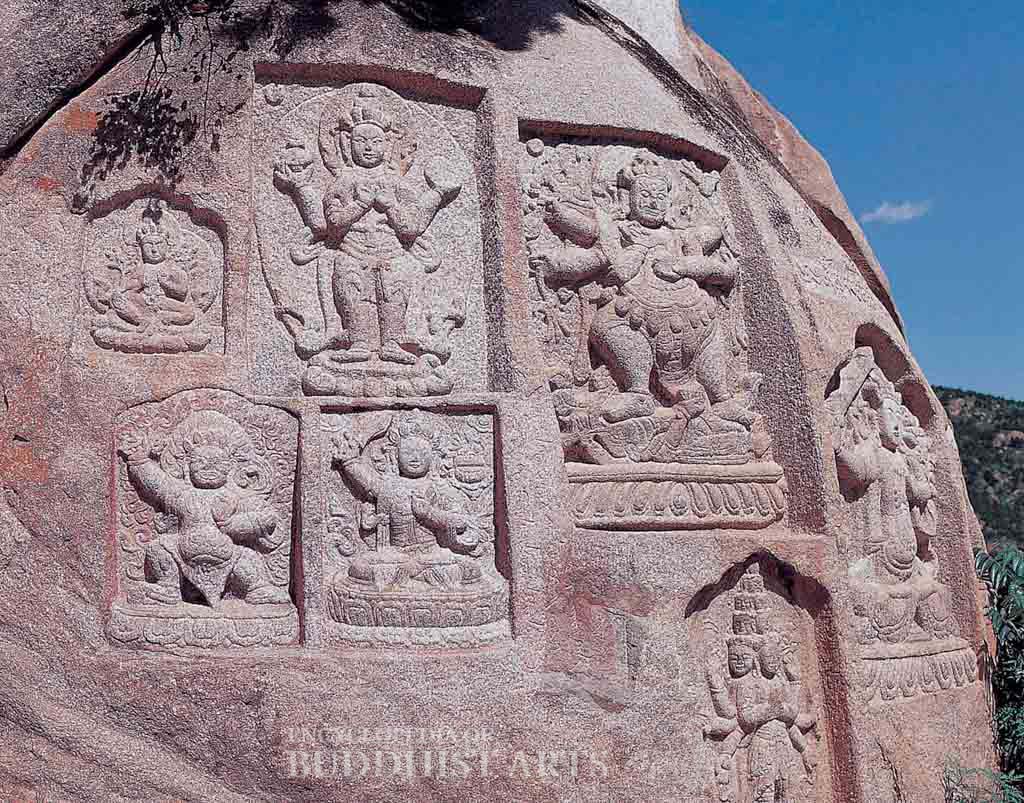
Haitangshan Rock Carvings (detail)
Haitangshan Rock Carvings
CHINA, Liaoning, Fuxin
These rock carvings were made during the Qing dynasty (1644–1911). As recorded in the Fuxin County Gazetteer, the first Maidari Khutughtu and his six followers constructed the Pu’an Temple on this mountain in 1683. The rock carvings were created around the same time.
The 200 carvings on the Haitang cliff are all Vajrayana Buddhist images. They are distributed over granite surfaces across 2 sq km. The images range from 0.3 m to 5 m in height, and depict figures such as Buddhas, Bodhisattvas, and Tsongkapa. Some of the niches are accompanied by inscriptions written in Mongolian, Manchu, and Tibetan languages. The techniques employed in the carvings are bas-relief, sunk relief, high relief, and line engraving.
For more details, go to the Encyclopedia of Buddhist Arts: Caves R-L, page 420.
Cite this article:
author = Hsingyun and Youheng and Johnson, Peter and Mankuang and Huntington, Susan and Edson, Gary and Neather, Robert,
booktitle = {Encyclopedia of Buddhist Arts: Caves R-L},
pages = 420,
title = {{Haitangshan Rock Carvings}},
volume = 6,
year = {2016}}