
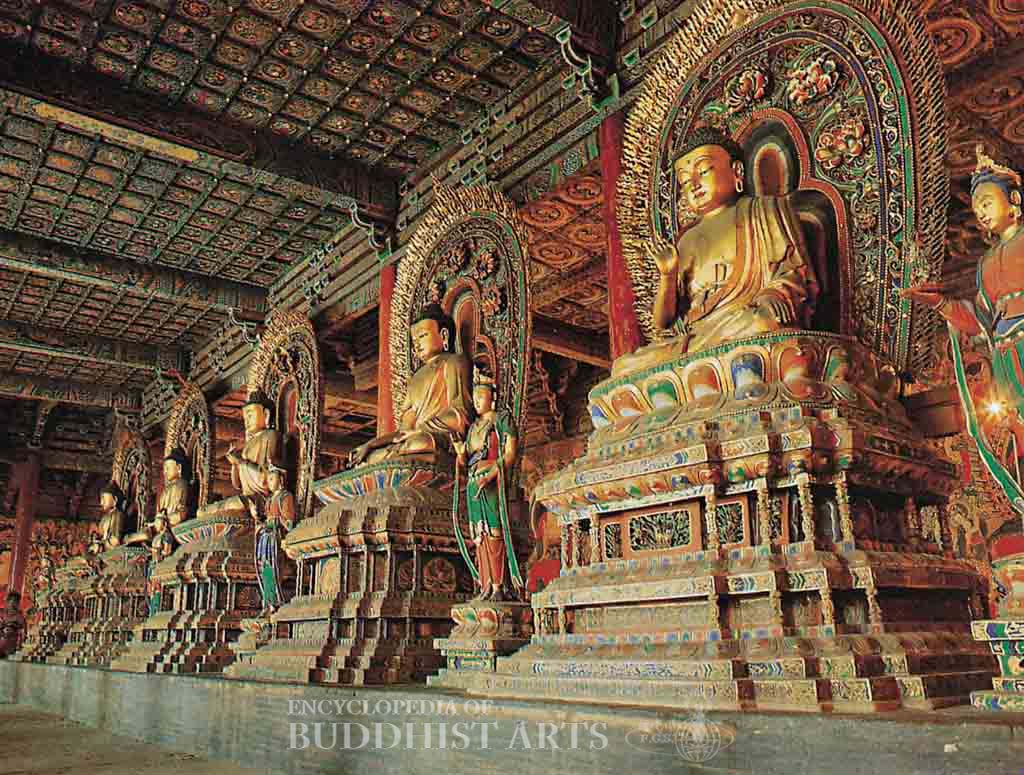
Huayan Upper Temple Great Hero Hall: Five Dhyani Buddhas
Clay
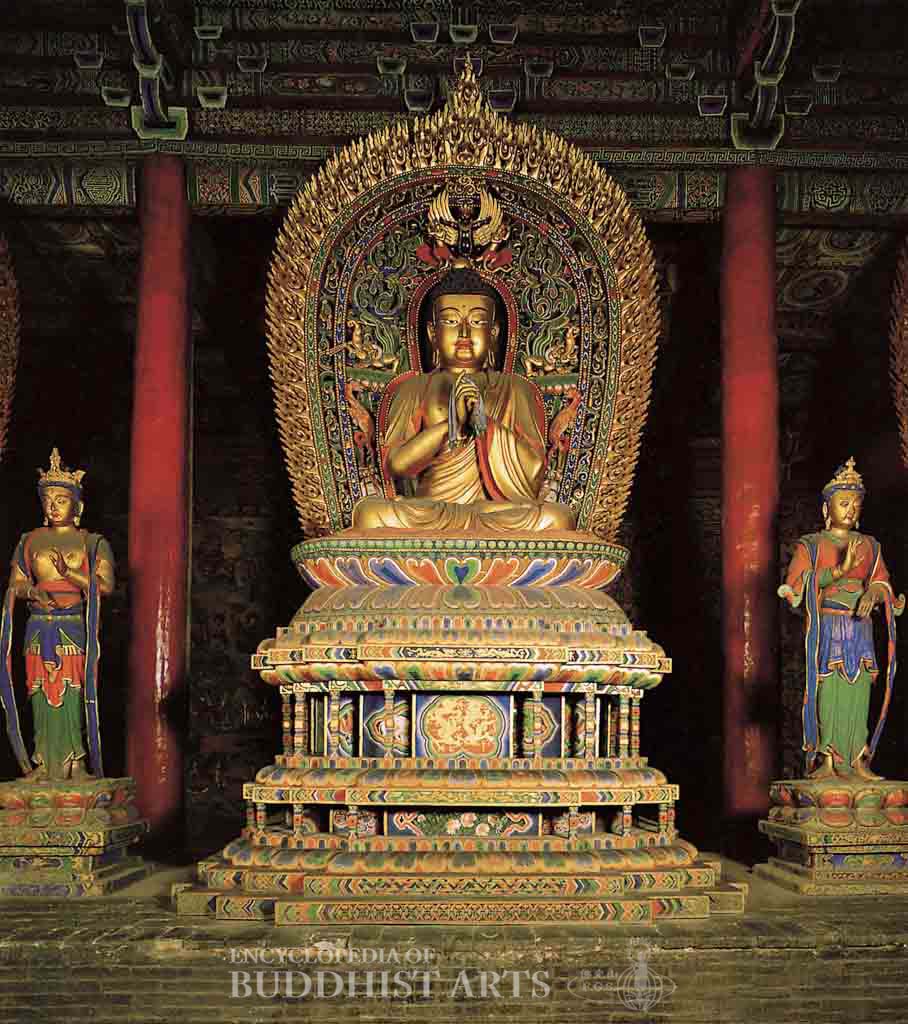
Huayan Upper Temple Great Hero Hall: Five Dhyani Buddhas - Vairocana Buddha
Huayan Upper Temple Great Hero Hall: Five Dhyani Buddhas
CHINA, Shanxi, Datong; Ming dynasty
The Five Dhyani Buddhas each have a Bodhisattva standing alternatively between them, making six Bodhisattvas in all. Statues of 20 heavenly beings, created during the Ming dynasty (1368–1644) line the side walls. The three Buddhas in the center are made from wood and were carved between 1426 and 1435 according to records, while the two remaining Buddhas are sculpted from clay and created between 1450 and 1457. They were repainted during the Qing dynasty (1644–1911). The Buddhas are, starting from the left, Aksobhya Buddha of the east, Ratnasambhava Buddha of the south, Vairocana Buddha of the center, Amitabha Buddha of the west, and Amoghasiddhi Buddha of the north.
All five Buddhas are similar in appearance. They are seated upon double lotus thrones that are supported on multi-tier Sumeru bases. They wear monastic robes that leave the right shoulder bare and each figure makes their characteristic mudra. The main variation is the fact that the two outer Buddhas, created at a later period, have slightly different facial features.
All the mandorlas are magnificent pieces of artwork filled with decorations radiating outwards and edged with layers of flames. They feature several decorated bands, the large inner rim of which has a foliated design, followed by three narrower bands with simpler designs, and flames around the outer rim. The inner rim also has various golden details from mythical creatures to swirling flowers.
The bases on which the thrones are supported feature many angled insets decorated with geometrical and floral designs and supported by columns.
For more details, go to the Encyclopedia of Buddhist Arts: Sculpture G-M, page 468.
Cite this article:
author = Hsingyun and Youheng and Lovelock, Yann and Chou, Yuan and Huntington, Susan and Edson, Gary and Neather, Robert,
booktitle = {Encyclopedia of Buddhist Arts: Sculpture G-M},
pages = 468,
title = {{Huayan Upper Temple Great Hero Hall: Five Dhyani Buddhas}},
volume = 11,
year = {2016}}