
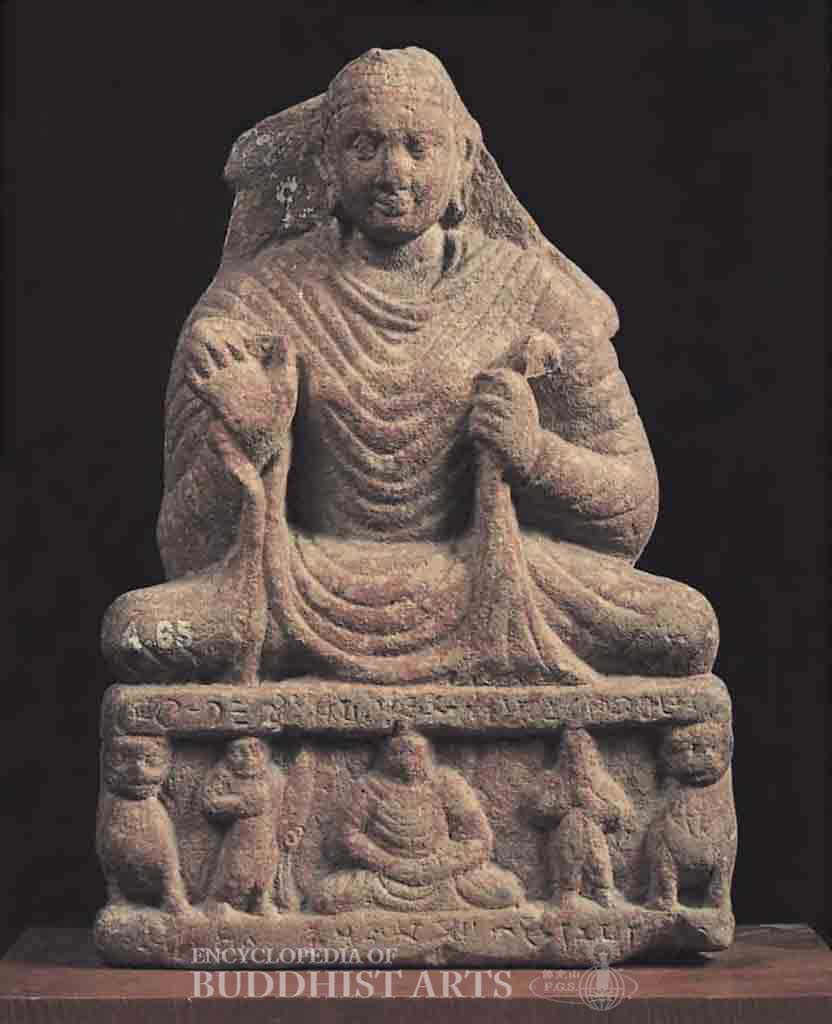
Mathura: Seated Buddha
Sandstone
Mathura: Seated Buddha
INDIA, Uttar Pradesh, Mathura
The statue was unearthed from Anyor, Mathura. Damage to the top of the statue has removed the usnisa and the nimbus behind the head. The Buddha sits cross-legged on a carved throne with the right hand likely in abhaya (fearlessness) mudra. The left hand grasps the hem of the heavy monastic robe that covers both shoulders. Folds ripple in a regular pattern down the robe in a style derived from Gandhara.
The throne depicts a meditating Buddha flanked on either side by attendants, beyond whom lions crouch as supports at the corners. Above and below these figures are inscriptions that date the work to the late 2nd century of the Kushan period (circa 1st–3rd century). In the inscription, the figure is called a Bodhisattva, a term that at that time referred to the Buddha.
For more details, go to the Encyclopedia of Buddhist Arts: Sculpture G-M, page 706.
Cite this article:
author = Hsingyun and Youheng and Lovelock, Yann and Chou, Yuan and Huntington, Susan and Edson, Gary and Neather, Robert,
booktitle = {Encyclopedia of Buddhist Arts: Sculpture G-M},
pages = 706,
title = {{Mathura: Seated Buddha}},
volume = 11,
year = {2016}}