
Pagoda
Gilt bronze
Pagoda
KOREA; Goryeo dynasty
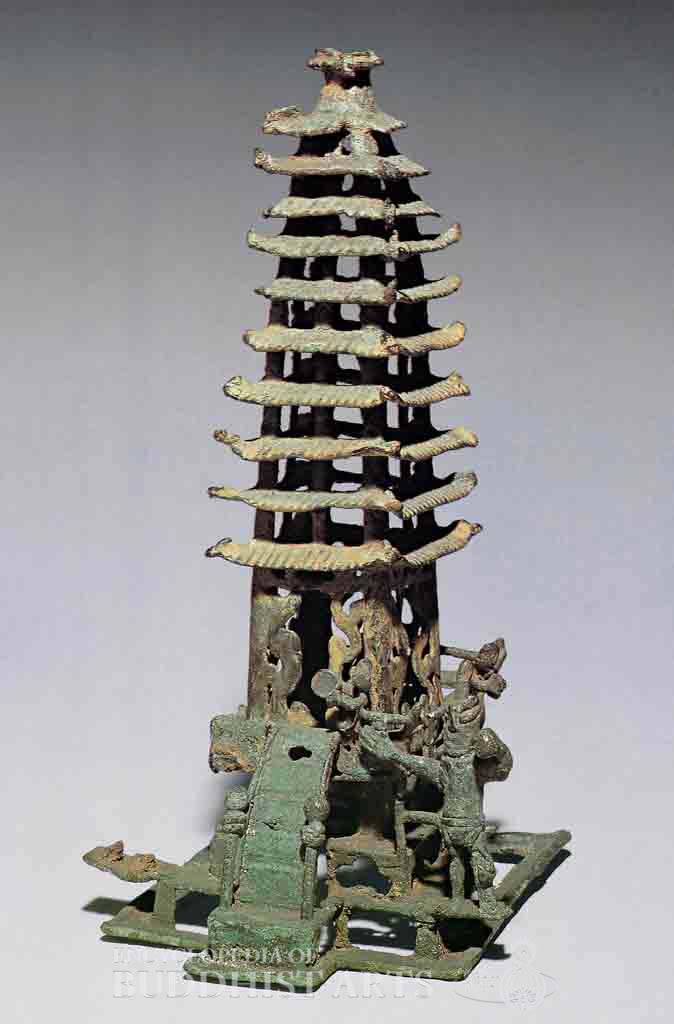
The pagoda consists of a base, body, and spire, of which only the harmika remains. It is well-preserved and provides invaluable information for the study of metalwork from the Goryeo dynasty (918–1392).
The three-layer base has steps at the front and back. At the front there used to be a warrior on either side, but the one on the left is missing. The first tier of the pagoda body is higher than the rest. Its walls are decorated with an openwork scroll leaf pattern and it is surrounded by balustrades, on which there were four heavenly musicians; however, two of them are missing. From the second tier upward, the pagoda is hollow with a few supporting columns. The roofs are covered with corrugated tiles and are decorated with ridge ornaments. Most of the gilding has worn away, leaving only some on the base.
From the style of the base and the technique used to create the heavenly musicians and warriors, it is believed to be a work of art from the 13th century.
For more details, go to the Encyclopedia of Buddhist Arts: Artifacts, page 217.
Cite this article:
author = Hsingyun and Youheng and Youji and Pokorski, Stefanie and Mankuang and Fan, Wen,
booktitle = {Encyclopedia of Buddhist Arts: Artifacts },
pages = 217,
title = {{Pagoda}},
volume = 18,
year = {2016}}