
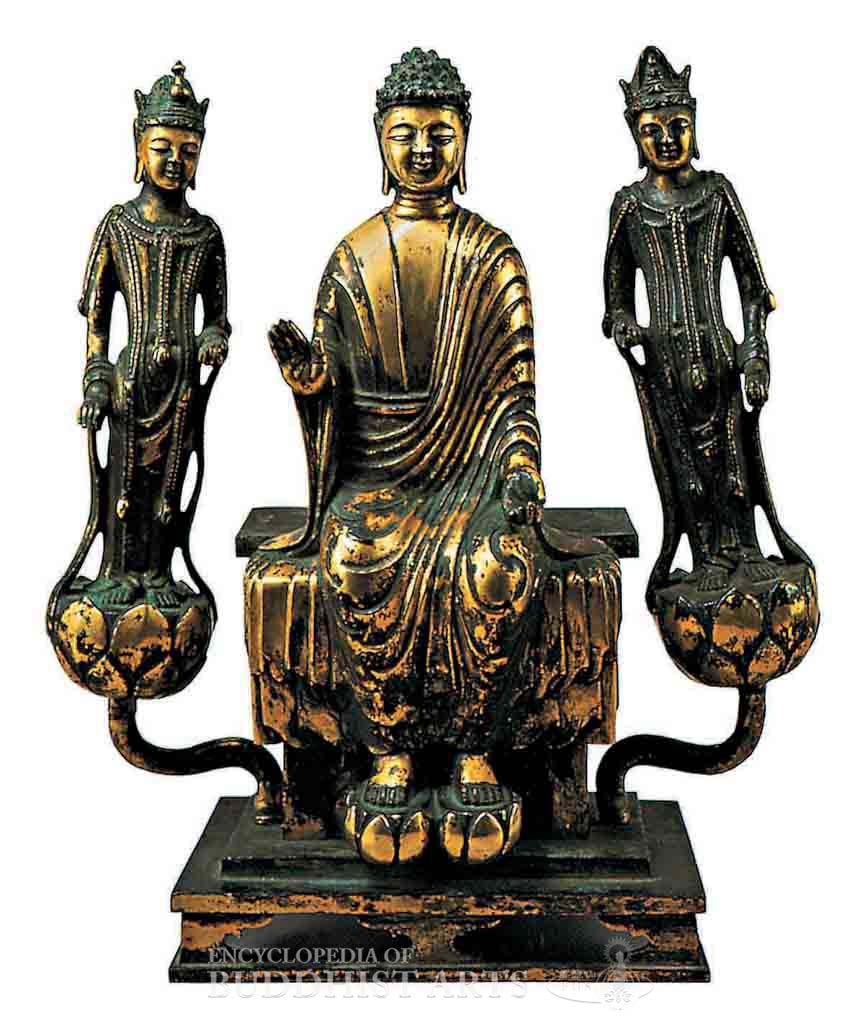
Horyuji Temple: Amitabha Buddha Triad
Gilt bronze
Horyuji Temple: Amitabha Buddha Triad
JAPAN, Nara, Ikoma; Asuka period
This is the earliest existing Amitabha Buddha triad in Japan and dates to the 7th century. It demonstrates the popularity of the Amitabha Buddha belief during the Asuka period (538–645). The piece is in fair condition except that the Buddha’s mandorla and the Bodhisattvas’ nimbuses are missing. It was a treasure presented to the imperial court by Horyuji Temple. It is listed as Treasure No. 144 of Horyuji Temple and is an Important Cultural Property of Japan.
Amitabha Buddha is dressed in a monastic robe and sits on a pedestal with the right hand in abhaya (fearlessness) mudra and the left hand in varada (wish-granting) mudra. Lotuses support both feet, while the flanking Bodhisattvas stand on lotus that rise from the rectangular base. Avalokitesvara is on the right and wears a crown with a Buddha image. Mahasthamaprapta wears a crown with a jeweled crest. A jeweled necklet is about the shoulders of both with long pendants and stoles that wind over their arms to overlap the pedestals beneath.
The style of the throne, as well as the crown and jewelry worn by the Bodhisattvas are reminiscent of the style found on Northern Qi (550–577) and Sui (581–618) dynasty sculptures.
For more details, go to the Encyclopedia of Buddhist Arts: Sculpture G-M, page 444.
Cite this article:
author = Hsingyun and Youheng and Lovelock, Yann and Chou, Yuan and Huntington, Susan and Edson, Gary and Neather, Robert,
booktitle = {Encyclopedia of Buddhist Arts: Sculpture G-M},
pages = 444,
title = {{Horyuji Temple: Amitabha Buddha Triad}},
volume = 11,
year = {2016}}