
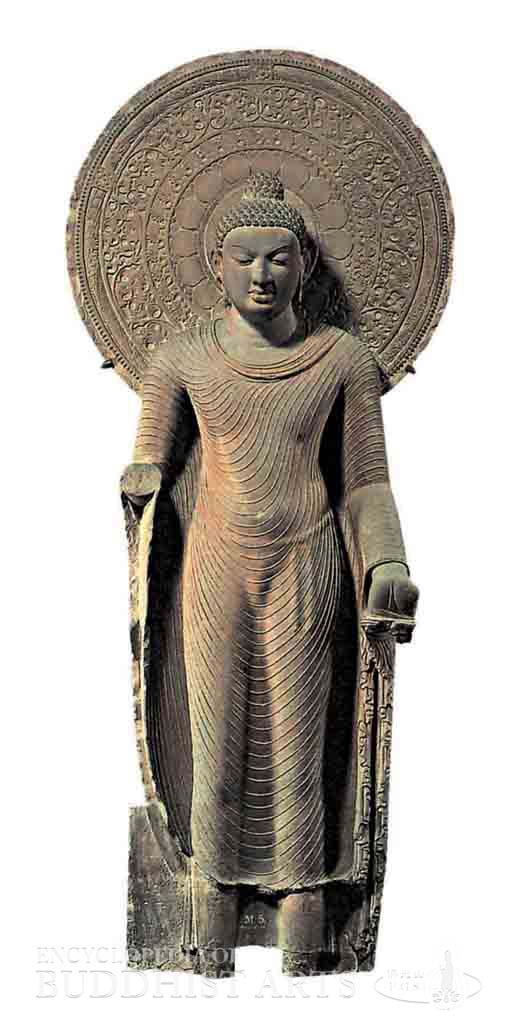
Mathura: Standing Buddha
Red sandstone
Mathura: Standing Buddha
INDIA, Uttar Pradesh, Mathura
Discovered at Jamalpur, Mathura, the statue is carved in Mathura style. Its slender frame replaces the more robust figure produced during the Kushan period (circa 1st–3rd century). The gentler, more rounded contours are a Gupta trait. The nimbus is also larger in size but similar to the Kushan design. The main difference is the lotus behind the head, beyond which are differently sized bands of floral and foliate patterns, succeeded by the familiar beaded rim and scalloped edge.
The Buddha has a high usnisa covered in neatly aligned curls; the eyes are cast down, the nose is broad and the lower lip thick. Both shoulders are covered by a diaphanous robe. The material clings to the body and has a continuous pattern of folds rippling its length.
For more details, go to the Encyclopedia of Buddhist Arts: Sculpture G-M, page 709.
Cite this article:
author = Hsingyun and Youheng and Lovelock, Yann and Chou, Yuan and Huntington, Susan and Edson, Gary and Neather, Robert,
booktitle = {Encyclopedia of Buddhist Arts: Sculpture G-M},
pages = 709,
title = {{Mathura: Standing Buddha}},
volume = 11,
year = {2016}}