
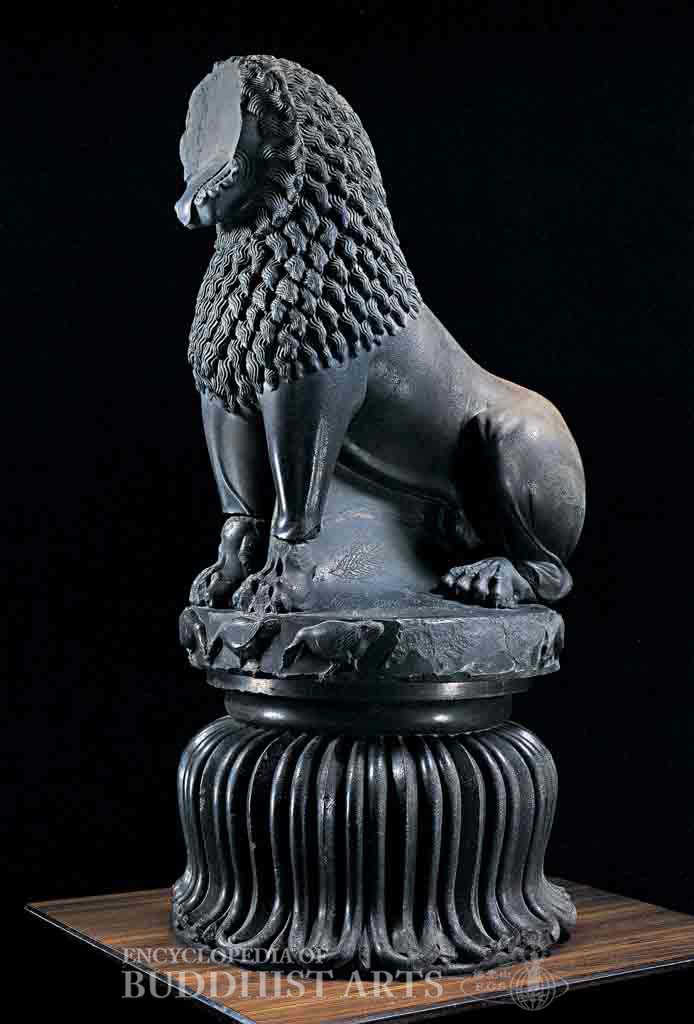
Rampurva: Lion Capital of an Asoka Pillar
Sandstone
Rampurva: Lion Capital of an Asoka Pillar
INDIA, Bihar, Rampurva
The capital is in a dark gray color, unlike other Asoka pillars, and is believed to have resulted from air pollution. Placement of the capital at the entrance of the Indian Museum in Kolkata more than 100 years ago has resulted in its discoloration. Scholars believe that it should have originally been in a light sandy color.
The animal still retains its regal bearing as well as its thick stylized mane despite the damage to the face. Certain features of the imposing beast were influenced by the Persian Achaemenian Empire (circa 559–330 BCE), such as the stiffened front legs and the powerful claws. The lion sits on a circular pedestal whose sides are adorned with geese and is mounted on top of an inverted bell-shaped lotus flower.
For more details, go to the Encyclopedia of Buddhist Arts: Sculpture N-Sr, page 874.
Cite this article:
author = Hsingyun and Youheng and Lovelock, Yann and Chou, Yuan and Huntington, Susan and Edson, Gary and Neather, Robert,
booktitle = {Encyclopedia of Buddhist Arts: Sculpture N-Sr},
pages = 874,
title = {{Rampurva: Lion Capital of an Asoka Pillar}},
volume = 12,
year = {2016}}