
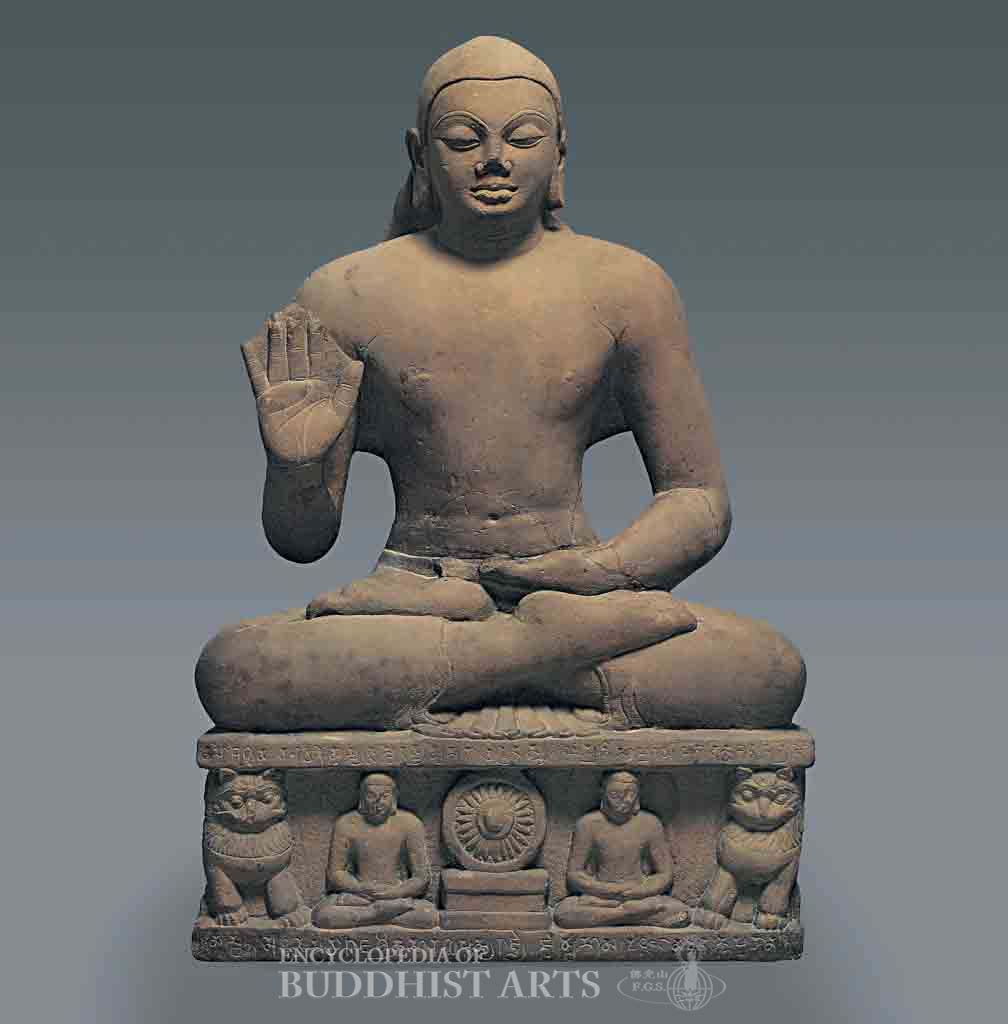
Mankuwar: Seated Buddha
Sandstone
Mankuwar: Seated Buddha
INDIA, Uttar Pradesh, Mankuwar
The statue was unearthed in Mankuwar and dates to 448 from the inscription along the lower edge of the throne. The sculptural style shows ties with both Sarnath and Mathura. The most distinctive Mathura features include the flat nose, a meditative demeanor, and the well proportioned figure, while the diaphanous lower garment is characteristic of Sarnath.
The figure’s shaved head is smooth and similar to sculptures of the founder of Jainism found in Mathura. The nimbus behind has almost completely disappeared. The webbed right hand is in abhaya (fearlessness) mudra, while the left hand rests on the lap. The upper body is bare and the skirt is chiefly indicated by an upper hem and the fall of the material over the calves to a fan-like formation of pleats beneath. The Buddha sits in full lotus position on a lion throne decorated with a Dharma wheel flanked by seated Buddhas.
For more details, go to the Encyclopedia of Buddhist Arts: Sculpture G-M, page 687.
Cite this article:
author = Hsingyun and Youheng and Lovelock, Yann and Chou, Yuan and Huntington, Susan and Edson, Gary and Neather, Robert,
booktitle = {Encyclopedia of Buddhist Arts: Sculpture G-M},
pages = 687,
title = {{Mankuwar: Seated Buddha}},
volume = 11,
year = {2016}}