
Mathura: Life of the Buddha
Red sandstone

Mathura: Life of the Buddha (detail)
Mathura: Life of the Buddha
INDIA, Uttar Pradesh, Mathura
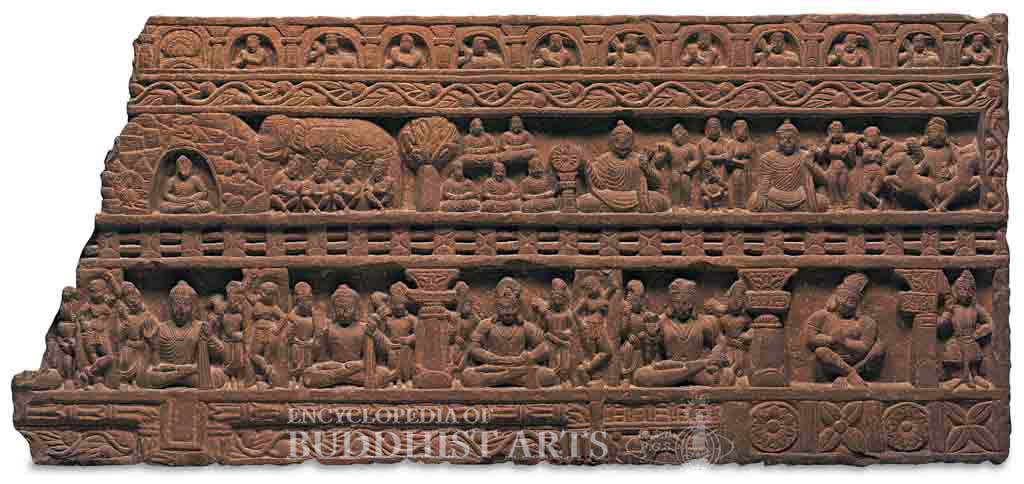
The broken section of this banded relief may originally have been from the middle of a larger work. The scenes it represents are divided between two registers, the one above illustrating the life of Sakyamuni Buddha while the one below has been tentatively identified as depicting the Seven Buddhas of the Past. Along the top, there is a row of niches containing figures, either facing to the left with palms joined in reverence or with a whisk held over their shoulder. They are divided by short columns and look over a balustrade with a running plant motif. A similar motif runs along the bottom.
On the upper register to the far right is the sun god, Surya, accompanied by four horses. Beyond this is a large Buddha making the bhumisparsa (earth-touching) mudra representing the Defeat of Mara. On the right are two of Mara’s daughters dancing enticingly, while two more are on the left with Mara squatting at their feet in defeat.
The next large Buddha is delivering the first teaching, known as the First Turning of the Dharma Wheel, which is done with the Buddha’s hand on an actual wheel. On the other side of this the five former companions in ascetic practices sit listening. The last scene depicts the teaching at Sakra’s Cave, where the meditating Buddha is visited by Sakra and retinue. They are sitting on the ground with their elephant behind them.
Along the bottom register on the far right is a standing warrior with a spear, divided by a pillar from a crowned figure sitting with ankles crossed and palms joined in reverence. The following statues are a pair of Bodhisattvas, identified by their rich headdress and jewelry, who are surrounded by heavenly beings. Both Bodhisattvas sit in full lotus position with hands in abhaya (fearlessness) and dhyana (meditation) mudras respectively. Beyond them are two cross-legged Buddhas wearing monastic robes with their right hand in the abhaya mudra, similarly attended by heavenly beings with whisks.
For more details, go to the Encyclopedia of Buddhist Arts: Sculpture G-M, page 698.
Cite this article:
author = Hsingyun and Youheng and Lovelock, Yann and Chou, Yuan and Huntington, Susan and Edson, Gary and Neather, Robert,
booktitle = {Encyclopedia of Buddhist Arts: Sculpture G-M},
pages = 698,
title = {{Mathura: Life of the Buddha}},
volume = 11,
year = {2016}}