
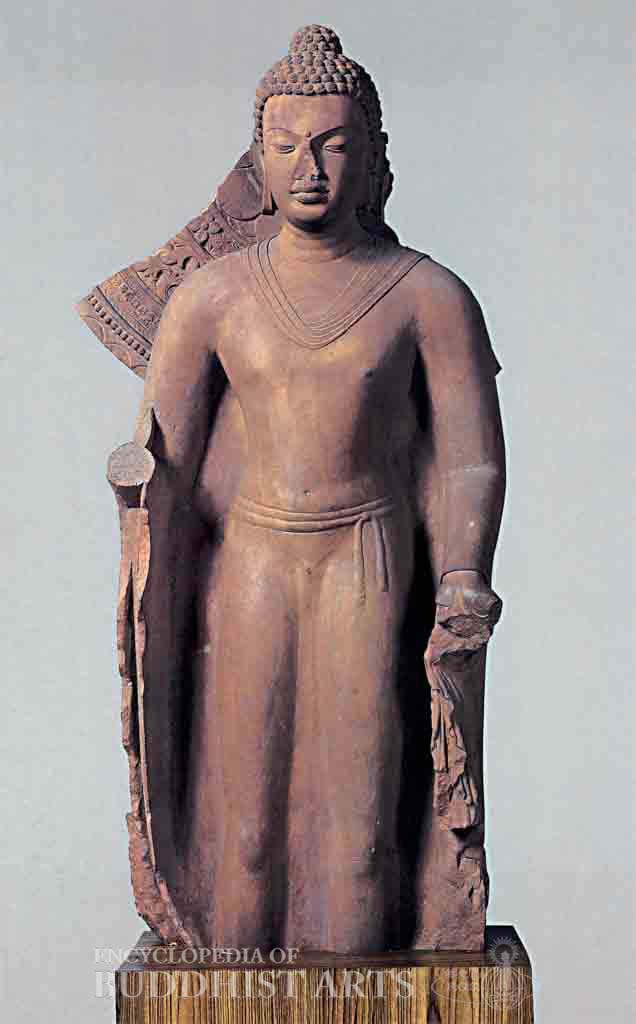
Bazipur: Standing Buddha
Sandstone
Bazipur: Standing Buddha
INDIA, Uttar Pradesh, Bazipur; Gupta period
This statue, unearthed at Bazipur, was created during the Gupta period (circa 320–550). It encompasses the styles of Mathura and Sarnath. The Mathura style is especially prominent and can be seen in the head, as well as the remains of the nimbus. Although the hands and lower legs are missing, the rest of the statue is well preserved.
The Buddha has tightly curled hair, a prominent usnisa, and a high forehead. He has distinctive eyebrows, large eyes, a broad nose, thick lips, and a wide mouth. The diaphanous robe covers both shoulders and is plain, except for some pleats along the V-shaped neckline and the sleeves beneath the left arm.
For more details, go to the Encyclopedia of Buddhist Arts: Sculpture A-F, page 126.
Cite this article:
Hsingyun, et al. "Bazipur: Standing Buddha." Encyclopedia of Buddhist Arts: Sculpture A-F, vol. 10, 2016, pp. 126.
Hsingyun, Youheng, Yann Lovelock, Yuan Chou, Susan Huntington, Gary Edson, and Robert Neather. 2016. "Bazipur: Standing Buddha" In Encyclopedia of Buddhist Arts: Sculpture A-F, 10:126.
Hsingyun, Youheng, Lovelock, Y., Chou, Y., Huntington, S., Edson, G., & Neather, R.. (2016). Bazipur: Standing Buddha. In Encyclopedia of Buddhist Arts: Sculpture A-F (Vol. 10, pp. 126).
@misc{Hsingyun2016,
author = Hsingyun and Youheng and Lovelock, Yann and Chou, Yuan and Huntington, Susan and Edson, Gary and Neather, Robert,
booktitle = {Encyclopedia of Buddhist Arts: Sculpture A-F},
pages = 126,
title = {{Bazipur: Standing Buddha}},
volume = 10,
year = {2016}}
author = Hsingyun and Youheng and Lovelock, Yann and Chou, Yuan and Huntington, Susan and Edson, Gary and Neather, Robert,
booktitle = {Encyclopedia of Buddhist Arts: Sculpture A-F},
pages = 126,
title = {{Bazipur: Standing Buddha}},
volume = 10,
year = {2016}}