
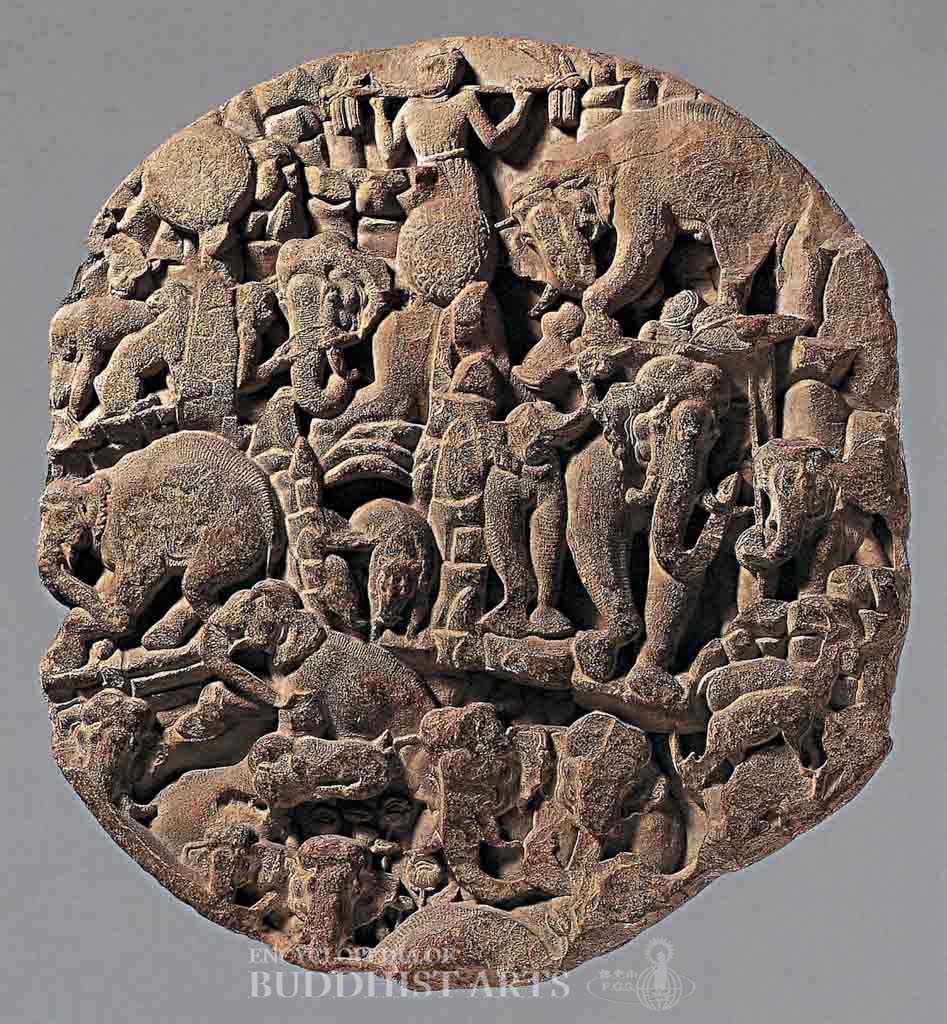
Amaravati: Saddanta Jataka
Limestone
Amaravati: Saddanta Jataka
INDIA, Andhra Pradesh, Amaravati; Satavahana period
The medallion depicts one of the former lives of the Buddha known as the Saddanta Jataka. The Buddha in this story is represented as an elephant king who is hunted for his six tusks and gives them up freely. Despite the medallion’s crowded organization, five recognizable events can be distinguished within the relief. The elephant king and queen are bathing in a lotus pond at the very bottom. The elephant king is depicted again in the center right, flanked by two attendant elephants, one holding a whisk and the other shielding him with a parasol. The elephant is strolling in the forest in the above section, and beneath him a hunter half hidden inside a cave raises his head to watch. The elephant stoops calmly to the left of the upper section to allow the hunter to cut off his tusks. The hunter is seen in the topmost section carrying the tusks on a shoulder pole. The spaces between each scene are filled with rocks, trees, and various animals. The medallion represents the earlier Indian-influenced approach in its composite narrative. Scenes in Gandharan sculpture are often arranged in sequential progression due to Greco-Roman influence, as they came to be later at Amaravati.
For more details, go to the Encyclopedia of Buddhist Arts: Sculpture A-F, page 26.
Cite this article:
author = Hsingyun and Youheng and Lovelock, Yann and Chou, Yuan and Huntington, Susan and Edson, Gary and Neather, Robert,
booktitle = {Encyclopedia of Buddhist Arts: Sculpture A-F},
pages = 26,
title = {{Amaravati: Saddanta Jataka}},
volume = 10,
year = {2016}}