
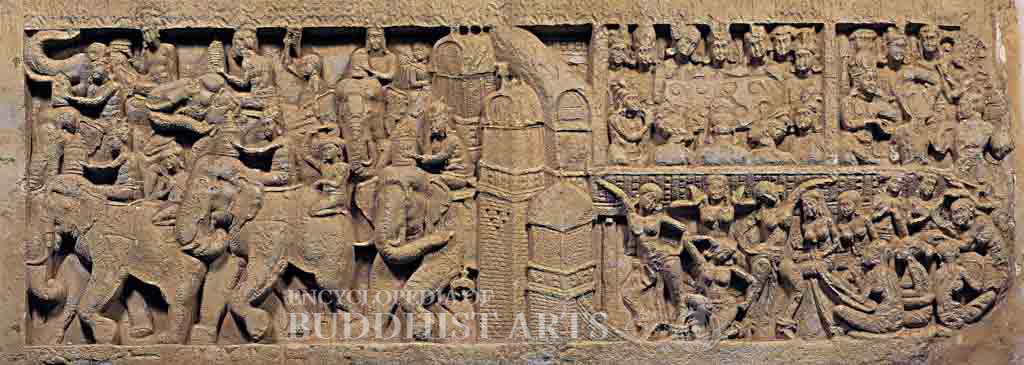
Amaravati: Life of the Buddha - Distribution of Relics Among the Eight Kings
Limestone

Amaravati: Life of the Buddha - Distribution of Relics Among the Eight Kings(detail)

Amaravati: Life of the Buddha - Distribution of Relics Among the Eight Kings(detail)
Amaravati: Life of the Buddha - Distribution of Relics Among the Eight Kings
INDIA, Andhra Pradesh, Amaravati; Satavahana period
The relief once decorated the railings that surrounded the Amaravati Stupa. It illustrates the story of how the Buddha’s relics were distributed after his cremation. It was most likely created during the time when the style at the site reached its peak, also known as the “railing era.” This style was responsible for the exceptional carvings found at this location.
There are four different scenes on the panel, with the largest on the left. The towers and walls of Kushinaga divide the scenes on the right. The city’s ruler, who refuses to share the relics, is visible on the top right corner. Adjoining this scene is the brahmin Drona, who divides the relics into eight portions on a large table surrounded by the other rulers. A group of women dance in celebration beneath these scenes.
The section on the left is larger than the rest and shows the seven crowned kings leaving Kushinaga and returning to their own countries. Each king carries his share of the relics in a reliquary balanced on the head of the elephant he is riding. The final elephant is emerging from the city’s gateway.
For more details, go to the Encyclopedia of Buddhist Arts: Sculpture A-F, page 21.
Cite this article:
author = Hsingyun and Youheng and Lovelock, Yann and Chou, Yuan and Huntington, Susan and Edson, Gary and Neather, Robert,
booktitle = {Encyclopedia of Buddhist Arts: Sculpture A-F},
pages = 21,
title = {{Amaravati: Life of the Buddha - Distribution of Relics Among the Eight Kings}},
volume = 10,
year = {2016}}