
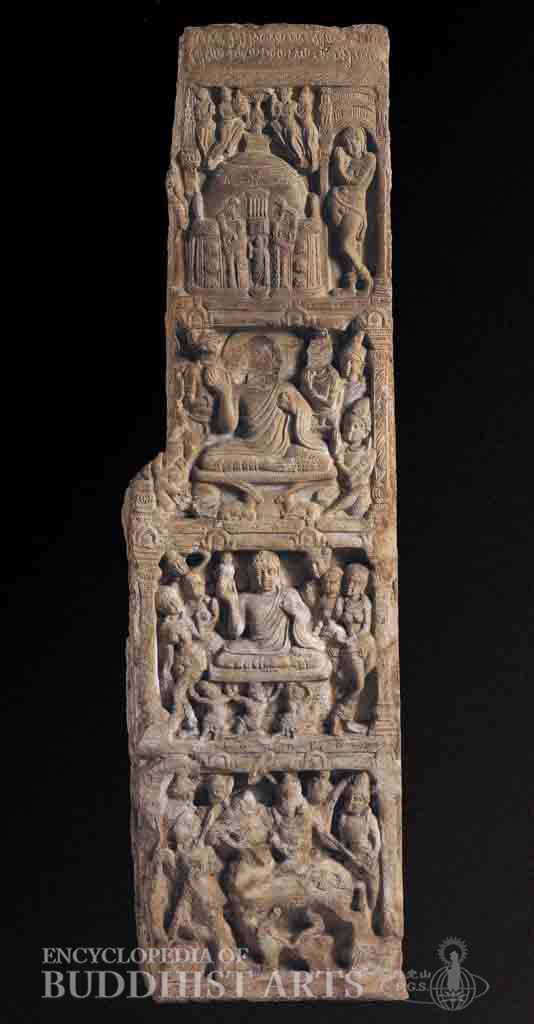
Amaravati: Life of the Buddha
Limestone

Amaravati: Life of the Buddha (third register)
Amaravati: Life of the Buddha
INDIA, Andhra Pradesh, Amaravati; Satavahana period
The stone tablet was unearthed from Amaravati and is believed to date to the late Satavahana period (circa 200 BCE–250 CE). Four scenes spanning the Buddha’s life are depicted. The sequence reads from bottom to top.
The lowest register depicts Prince Siddhartha’s departure from the palace. It is the most worn of the four but still recognizable as a figure riding a horse and escorted by heavenly beings. The next register depicts the prince defeating Mara and attaining enlightenment. Mara’s daughters and his army surround the prince as he sits in full lotus position on a throne. The prince makes the abhaya (fearlessness) mudra with his right hand.
The third register illustrates the Buddha’s first turning of the Dharma wheel. The scene is almost identical to the one below except for a different audience surrounding him. However, rather than his five former disciples, the listeners seem to be royalty, judging by their dress. The presence of a pair of deer below the throne identifies the place as Sarnath. The register at the top shows heavenly beings paying respect to a stupa.
For more details, go to the Encyclopedia of Buddhist Arts: Sculpture A-F, page 19.
Cite this article:
author = Hsingyun and Youheng and Lovelock, Yann and Chou, Yuan and Huntington, Susan and Edson, Gary and Neather, Robert,
booktitle = {Encyclopedia of Buddhist Arts: Sculpture A-F},
pages = 19,
title = {{Amaravati: Life of the Buddha}},
volume = 10,
year = {2016}}