
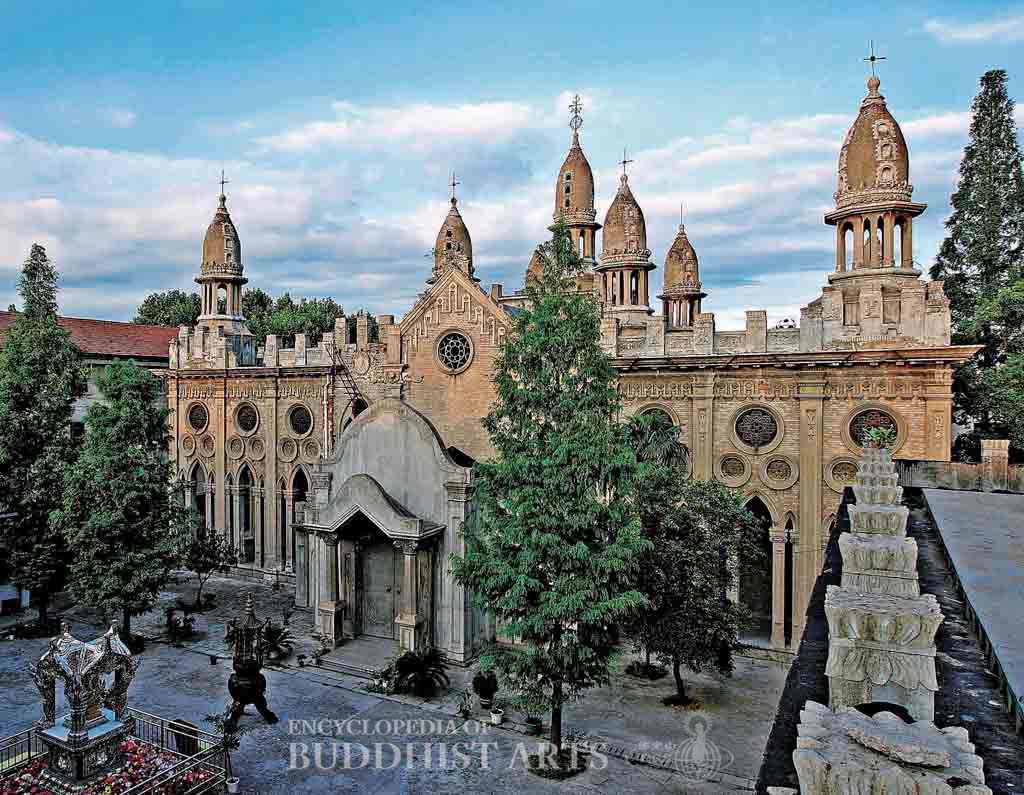
Gude Temple Perfect Understanding Hall
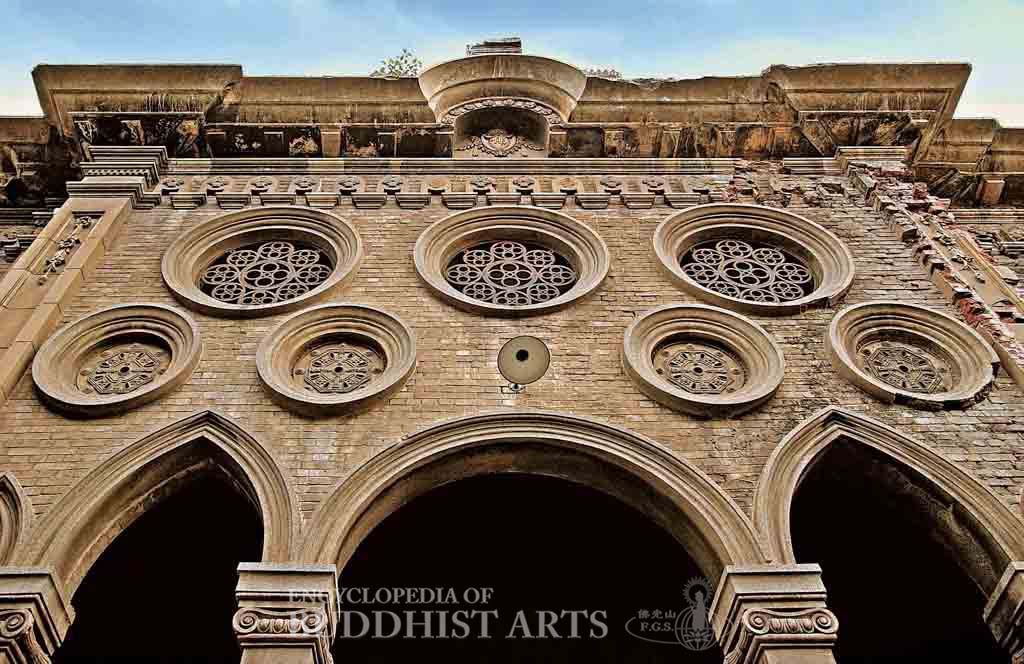
Gude Temple Perfect Understanding Hall
Gude Temple Perfect Understanding Hall
CHINA, Hubei, Wuhan
Construction of the hall started in 1921 and took 13 years to complete. The architectural style of the building was inspired by the Ananda Temple in Myanmar. Its structure consists of the main hall with a series of towers at the top. This unique style of Buddhist architecture is found nowhere else in China. It was listed as a Provincial Cultural Heritage Site in 1992.
The hall is a single-story, rectangular, brick building, which is 27 m long with an interior height of 16 m. The portico is built in gray stone. It is a prominent feature and is in two parts: at the front there are columns supporting a triangular roof; the rear part also has columns supporting an ogee arch doorway. The facade of the building features tall narrow archways with smaller archways on either side. There are round openwork windows above the archways. The facade is decorated with floral patterns, lion and elephant heads, and garudas. The center of the building rises up to form a triangular wall with a large openwork window at the center. At the top there are nine towers, which symbolize the five Buddhas and four Bodhisattvas. Each tower is surmounted by a tapered curved spire with shallow niches without images. The upper section of the hall is surrounded by 24 standing heavenly beings and supported by 96 lotus posts. The Buddhas of the Past, Present, and Future, as well as the Amitabha Buddha Triad, are enshrined inside the hall. Along the walls there are 25 Bodhisattvas and Arhats who have attained perfect understanding.
For more details, go to the Encyclopedia of Buddhist Arts: Architecture G-L, page 409.
Cite this article:
author = Hsingyun and Youheng and Johnson, Peter and Mankuang and Lancaster, Lewis,
booktitle = {Encyclopedia of Buddhist Arts: Architecture G-L},
pages = 409,
title = {{Gude Temple Perfect Understanding Hall}},
volume = 2,
year = {2016}}