
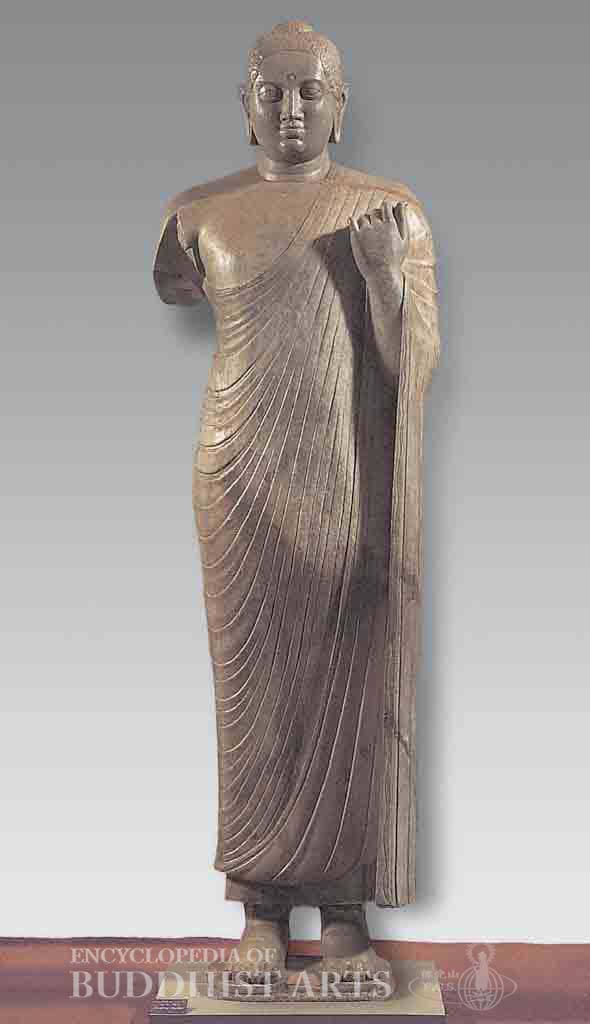
Nagarjunakonda: Standing Buddha
Limestone
Nagarjunakonda: Standing Buddha
INDIA, Andhra Pradesh
The statue was headless as well as lacking the right arm when first discovered, but the head has since been restored. The curls are merely suggested by incisions and lead up to a low usnisa. Other signs of the Buddha’s status are the urna, elongated earlobes and the three lines on the neck. The figure wears a monastic robe that leaves the right shoulder bare and conforms to the shape of the body as it falls in diagonally curving folds. Freestanding statues of the Buddha are rare in southern India, but those that have been discovered are predominantly sturdy, life-sized figures or larger.
For more details, go to the Encyclopedia of Buddhist Arts: Sculpture N-Sr, page 745.
Cite this article:
Hsingyun, et al. "Nagarjunakonda: Standing Buddha." Encyclopedia of Buddhist Arts: Sculpture N-Sr, vol. 12, 2016, pp. 745.
Hsingyun, Youheng, Yann Lovelock, Yuan Chou, Susan Huntington, Gary Edson, and Robert Neather. 2016. "Nagarjunakonda: Standing Buddha" In Encyclopedia of Buddhist Arts: Sculpture N-Sr, 12:745.
Hsingyun, Youheng, Lovelock, Y., Chou, Y., Huntington, S., Edson, G., & Neather, R.. (2016). Nagarjunakonda: Standing Buddha. In Encyclopedia of Buddhist Arts: Sculpture N-Sr (Vol. 12, pp. 745).
@misc{Hsingyun2016,
author = Hsingyun and Youheng and Lovelock, Yann and Chou, Yuan and Huntington, Susan and Edson, Gary and Neather, Robert,
booktitle = {Encyclopedia of Buddhist Arts: Sculpture N-Sr},
pages = 745,
title = {{Nagarjunakonda: Standing Buddha}},
volume = 12,
year = {2016}}
author = Hsingyun and Youheng and Lovelock, Yann and Chou, Yuan and Huntington, Susan and Edson, Gary and Neather, Robert,
booktitle = {Encyclopedia of Buddhist Arts: Sculpture N-Sr},
pages = 745,
title = {{Nagarjunakonda: Standing Buddha}},
volume = 12,
year = {2016}}