
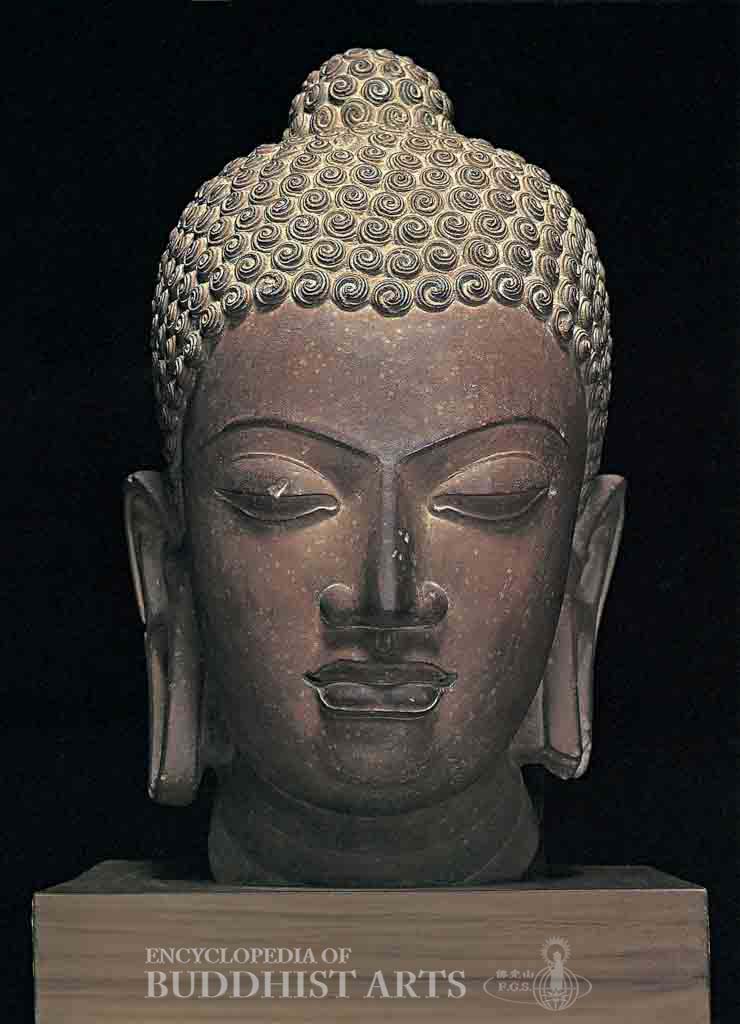
Mathura: Head of a Buddha
Red sandstone
Mathura: Head of a Buddha
INDIA, Uttar Pradesh, Mathura
Unearthed from Chamunda Tila, Mathura, the head displays the typical Mathura characteristics of the Gupta period (circa 320–550), such as the neatly arranged curls, the extended earlobes and the three lines on the neck associated with a great person. Some of the Buddha’s other Thirty-Two Marks of Excellence can be seen on the oval face, such as the slender eyebrows meeting above the straight line of the nose, the downward gaze and thick lower lip. Experts believe the urna may have been painted on. The features are accentuated by raised lines that further bring out the striking Indian appearance.
For more details, go to the Encyclopedia of Buddhist Arts: Sculpture G-M, page 694.
Cite this article:
Hsingyun, et al. "Mathura: Head of a Buddha." Encyclopedia of Buddhist Arts: Sculpture G-M, vol. 11, 2016, pp. 694.
Hsingyun, Youheng, Yann Lovelock, Yuan Chou, Susan Huntington, Gary Edson, and Robert Neather. 2016. "Mathura: Head of a Buddha" In Encyclopedia of Buddhist Arts: Sculpture G-M, 11:694.
Hsingyun, Youheng, Lovelock, Y., Chou, Y., Huntington, S., Edson, G., & Neather, R.. (2016). Mathura: Head of a Buddha. In Encyclopedia of Buddhist Arts: Sculpture G-M (Vol. 11, pp. 694).
@misc{Hsingyun2016,
author = Hsingyun and Youheng and Lovelock, Yann and Chou, Yuan and Huntington, Susan and Edson, Gary and Neather, Robert,
booktitle = {Encyclopedia of Buddhist Arts: Sculpture G-M},
pages = 694,
title = {{Mathura: Head of a Buddha}},
volume = 11,
year = {2016}}
author = Hsingyun and Youheng and Lovelock, Yann and Chou, Yuan and Huntington, Susan and Edson, Gary and Neather, Robert,
booktitle = {Encyclopedia of Buddhist Arts: Sculpture G-M},
pages = 694,
title = {{Mathura: Head of a Buddha}},
volume = 11,
year = {2016}}