
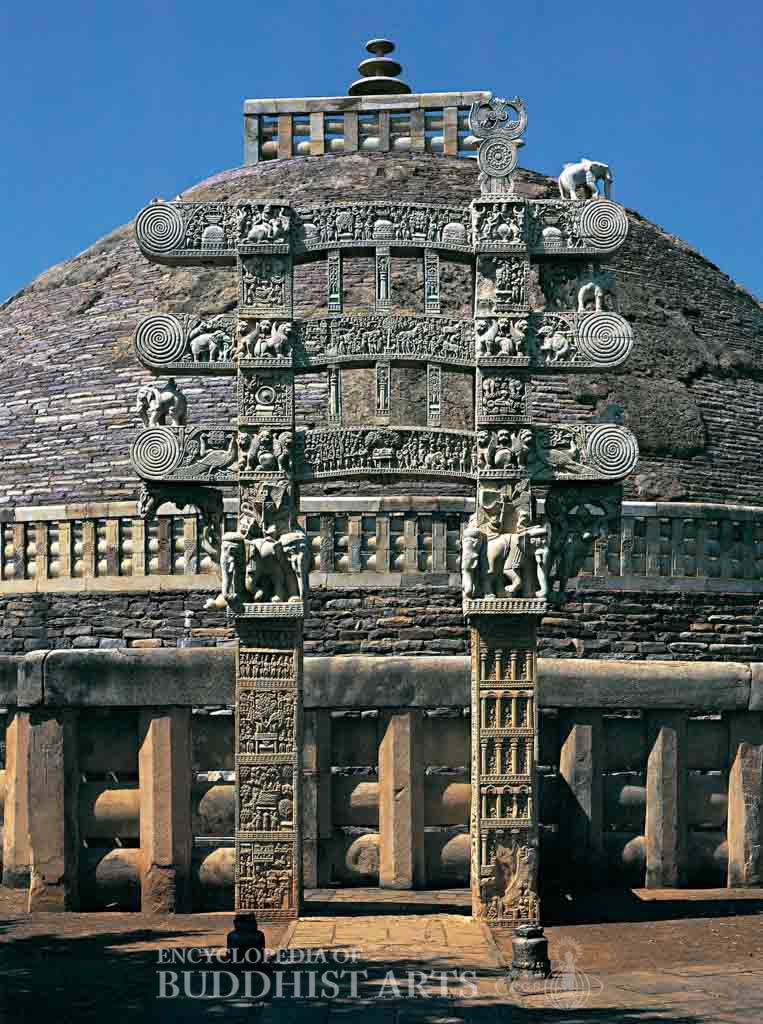
Sanchi Stupa Sculptures: Stupa 1 - Eastern Gateway
Sandstone
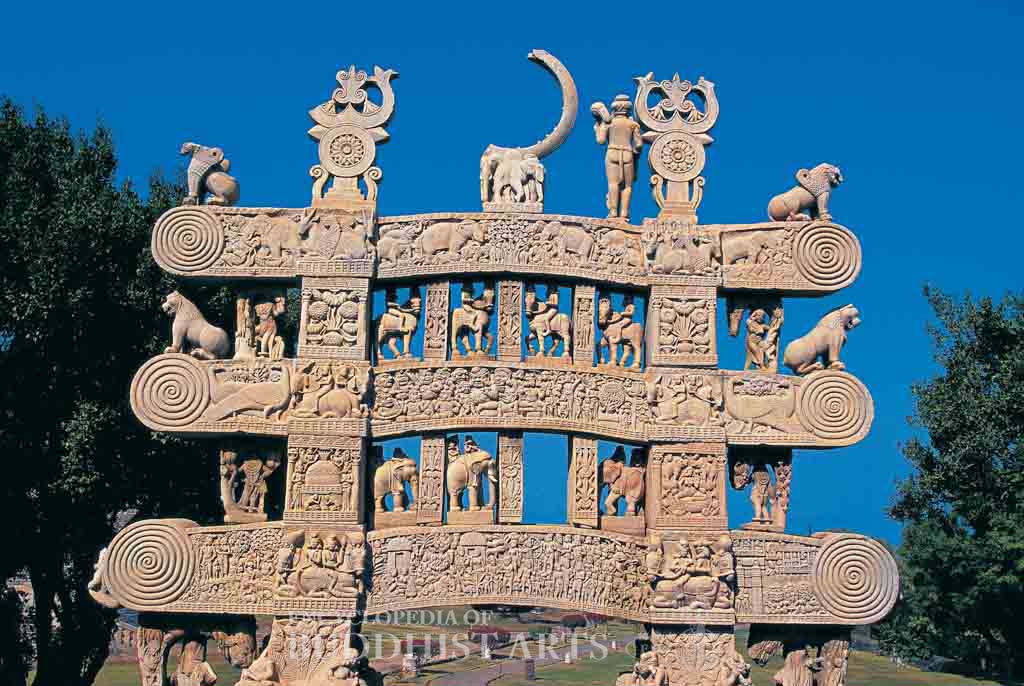
Sanchi Stupa Sculptures: Stupa 1 - Northern Gateway

Sanchi Stupa Sculptures: Stupa 2 - Naga King

Sanchi Stupa Sculptures: Stupa 2 - Triratna
Sanchi Stupa Sculptures
INDIA, Madhya Pradesh, Sanchi
Sanchi is one of the oldest existing Buddhist sites as well as the best preserved. The dates of Sanchi Stupas 1, 2 and 3 span from the 3rd century BCE to the 2nd century CE.
Stupa 1, also known as Sanchi Great Stupa, was built by King Asoka (reigned circa 269–232 BCE). Later, the original stupa was expanded and faced with stone, and in addition four stone gateways at the cardinal directions and the stone railings were added. The gateways, unlike the plain railings, are highly decorated with carvings. These include the triratna and Dharma wheel symbols as well as Dharma protectors at the very top of the columns. A set of three smaller blocks are located between each crossbar, also carved with protective symbols and deities. Between the small blocks are effigies of horses or elephants ridden by humans. More figures of winged lions, elephants, and yaksas standing beneath trees, are on either side of the crossbars.
The style of the reliefs indicates the southern gateway of Stupa 1 was the earliest to be constructed. The stupa’s remaining gates were completed soon after and possibly in the order of north, east, and west. Artworks include Life of the Buddha, Jataka tales, and many depicting the history of King Asoka. One group of artists who created these reliefs are identified as the ivory craftsman from the nearby town of Vedisagiri, according to information on the west side of the column on the southern gateway. The artists’ training is why the compositions are often highly condensed and resemble a gigantic ivory sculpture. Three most noteworthy pieces are the Chaddanta Jataka found on the southern gateway, the Prince Vessantara Jataka on the northern gateway, and the Great Departure depicted on the eastern gateway. A yaksini on the eastern gateway is in the tribhanga posture, later adopted in Indian art as the most graceful and sensual of female postures.
There are no gateways at Stupa 2, but its railings are still in good condition and are believed to date from the late 2nd century BCE. There are 88 posts with 500 medallion reliefs on them that were created during the Sunga period (circa 185–75 BCE). Many of the medallions are important milestones of Indian art history and include lotus flowers, as well as elephants, peacocks, multi-headed naga kings, and makaras. Reliefs found on the posts depict stupas, Bodhi trees, pillars, and other subjects.
Only the southern gateway still exists at Stupa 3 and its subject matter is largely similar to that of Stupa 1. The second crossbar shows a group of devotees paying respect to a stupa, which features a Dharma wheel. The relief on the third crossbar is the most vivid, includes Sakra’s palace and a great war between a naga king and a makara. These reliefs are newer than those of Stupa 1 and are generally believed to date from the first half of the 1st century CE.
For more details, go to the Encyclopedia of Buddhist Arts: Sculpture N-Sr, page 945.
Cite this article:
author = Hsingyun and Youheng and Lovelock, Yann and Chou, Yuan and Huntington, Susan and Edson, Gary and Neather, Robert,
booktitle = {Encyclopedia of Buddhist Arts: Sculpture N-Sr},
pages = 945,
title = {{Sanchi Stupa Sculptures}},
volume = 12,
year = {2016}}