
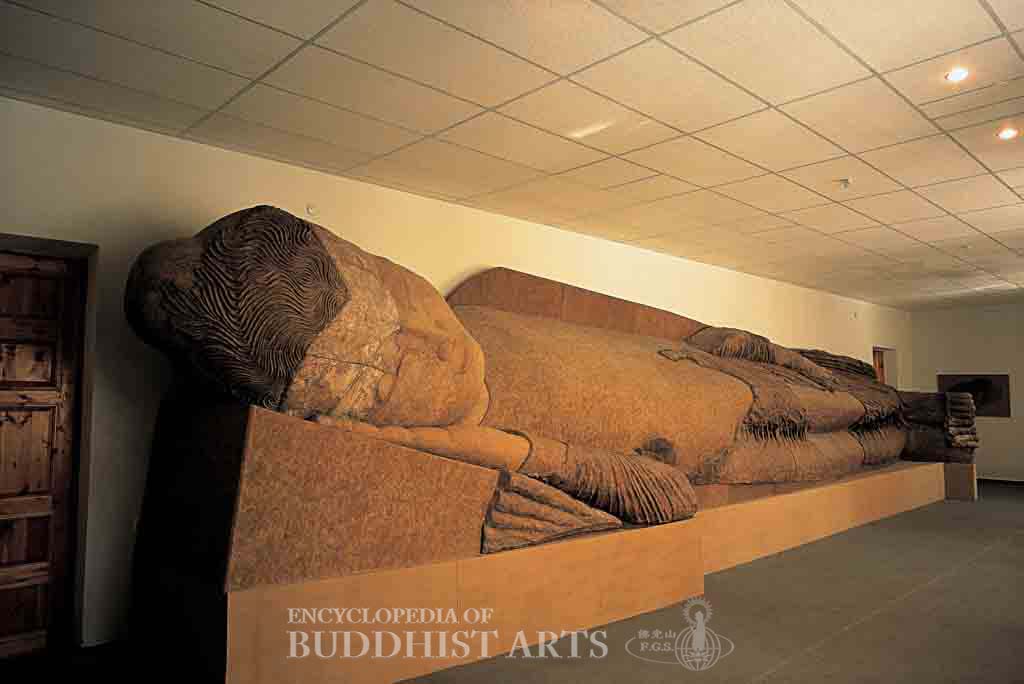
Ajina Tepe: Reclining Buddha
Terracotta
Ajina Tepe: Reclining Buddha
TAJIKISTAN, Khatlon
The reclining Buddha is the most important artifact discovered at the ruins of Ajina Tepe, where it was located in the eastern corridor of the temple compound. It was stored with other statues and murals damaged in the 8th century by Muslim invaders. The Tajikistan Museum of National Antiquities in Dushanbe reunited the fragments of the statue, unearthed in 1966 by archaeologists from the former Soviet Union, in 2001. The Buddha has a tall usnisa, wavy hair, closed eyes, and a serene expression. The right palm cushions the cheek while the left arm is laid flat along the body, with both legs firmly pressed together. Remnants of the robe can be seen about the forearms, waist, and lower legs. The serenity of this huge figure is clearly expressed as the Buddha passes into parinirvana despite the obvious traces of repair work.
For more details, go to the Encyclopedia of Buddhist Arts: Sculpture A-F, page 7.
Cite this article:
author = Hsingyun and Youheng and Lovelock, Yann and Chou, Yuan and Huntington, Susan and Edson, Gary and Neather, Robert,
booktitle = {Encyclopedia of Buddhist Arts: Sculpture A-F},
pages = 7,
title = {{Ajina Tepe: Reclining Buddha}},
volume = 10,
year = {2016}}