
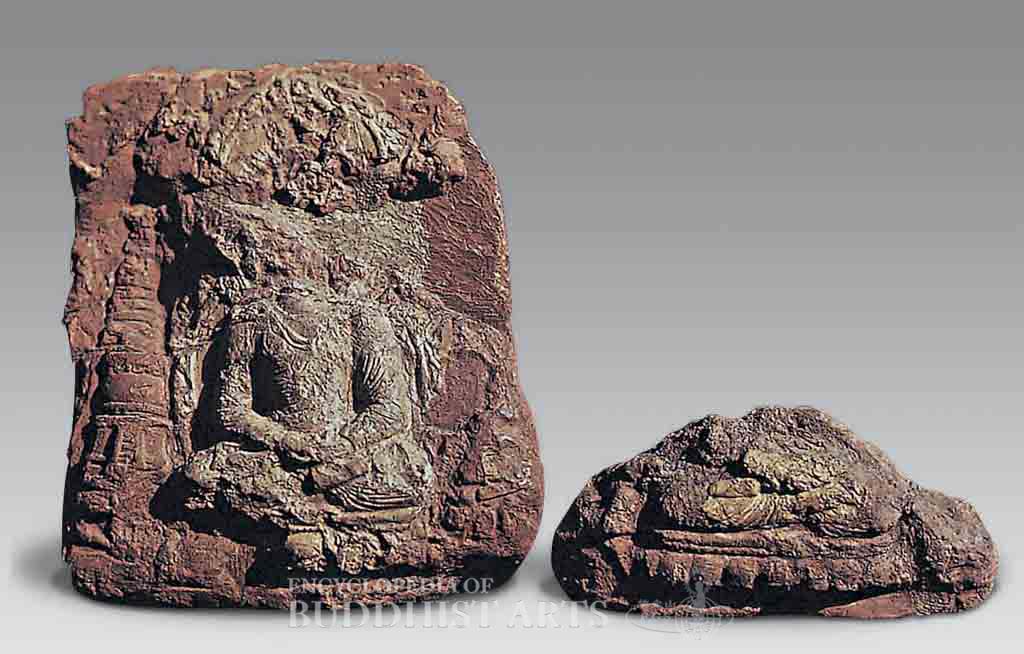
Ajina Tepe: Seated Buddhas
Clay
Ajina Tepe: Seated Buddhas
TAJIKISTAN, Khatlon
An estimated 100 to 120 sculptures were once featured at Ajina Tepe, including Buddhas, Bodhisattvas, and heavenly beings. Archaeologists speculate that local clay was mixed with lime, sand, straw, and other materials to give it a stronger body. Details such as the face, hair, hands, nimbus, ornaments, flower garland, and lotus throne were created with molds. The molded shapes were later attached onto the main part of the statue and then sun-dried. The head of the main Buddha is missing in this picture, but the patterned indentation that remains appear to incorporate the nimbus into the mandorla. The Buddha wears a monastic robe that covers both shoulders. He sits in the lotus position and remnants of the mandorla are discernible on either side of the body. A stupa with stairs leading up from the base is on the left. The stupa dome rises to a tapering structure of stacked rings.
For more details, go to the Encyclopedia of Buddhist Arts: Sculpture A-F, page 7.
Cite this article:
author = Hsingyun and Youheng and Lovelock, Yann and Chou, Yuan and Huntington, Susan and Edson, Gary and Neather, Robert,
booktitle = {Encyclopedia of Buddhist Arts: Sculpture A-F},
pages = 7,
title = {{Ajina Tepe: Seated Buddhas}},
volume = 10,
year = {2016}}