
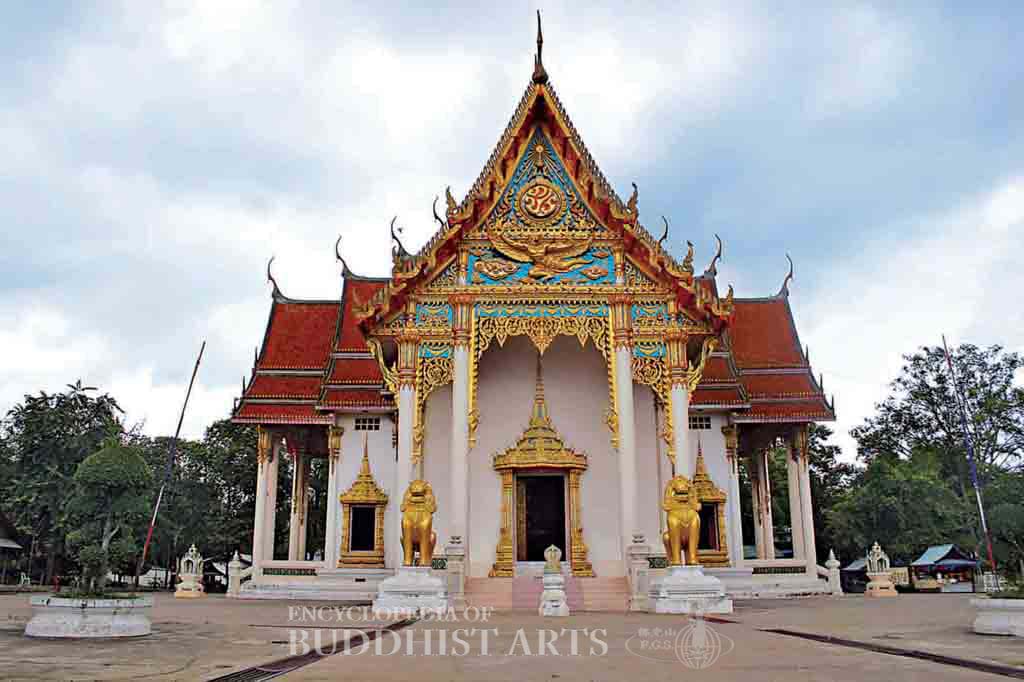
Wat Phra Thaen Dong Rang: Ordination Hall
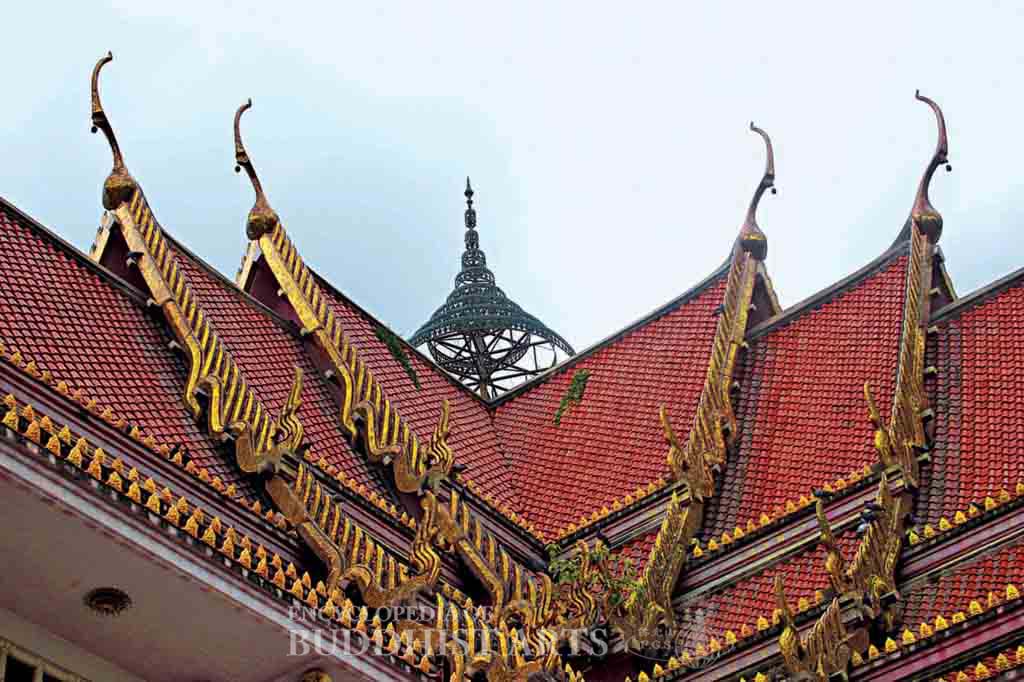
Wat Phra Thaen Dong Rang: Ordination Hall - Roof
Wat Phra Thaen Dong Rang
THAILAND, Kanchanaburi
The temple is named after a sacred stone, on which it is said that the Buddha rested prior to entering parinirvana. The full name of the temple is Wat Phra Thaen Dong Rang Woravihan. Its original construction date is unknown, but it is thought to have been built during the Ayutthaya period (circa 1350–1767). According to the Fine Arts Department of Thailand, the main hall that houses the sacred stone was built during the rule of King Rama I (reigned 1782–1809) or King Rama II (reigned 1809–1824), and was renovated under King Rama III (reigned 1824–1851). In 1863, during the rule of Rama IV (reigned 1851–1868), the ordination hall was completed. At the same time a stupa was erected behind the sacred stone. It underwent major renovation in 1922. In 1972 it was listed as a third class royal temple.
The most important building of the temple is the ordination hall, which is laid out on a square plan with multiple corners. Porticos project from the four sides. The exterior is marked with boundary stones indicating the boundaries of the ordination hall. A pair of golden lions flanks the main entrance. In the center of the cruciform roof there is a delicate filigree canopy. The ends of the ridges are decorated with garudas, while the bargeboards have naga scales and naga tails. The tiles are shaped like lotus petals. The pediment is high and accentuated, and it is decorated with a carving of a garuda spreading its wings and flying between the clouds. In the lower part of the pediment, between the columns, there are intricate gold filigree decorations. The window and door frames are beautifully embellished. Above the doorways and windows there are representations of stupas.
For more details, go to the Encyclopedia of Buddhist Arts: Architecture T-Z, page 1239.
Cite this article:
author = Hsingyun and Youheng and Johnson, Peter and Mankuang and Lancaster, Lewis,
booktitle = {Encyclopedia of Buddhist Arts: Architecture T-Z},
pages = 1239,
title = {{Wat Phra Thaen Dong Rang}},
volume = 4,
year = {2016}}