
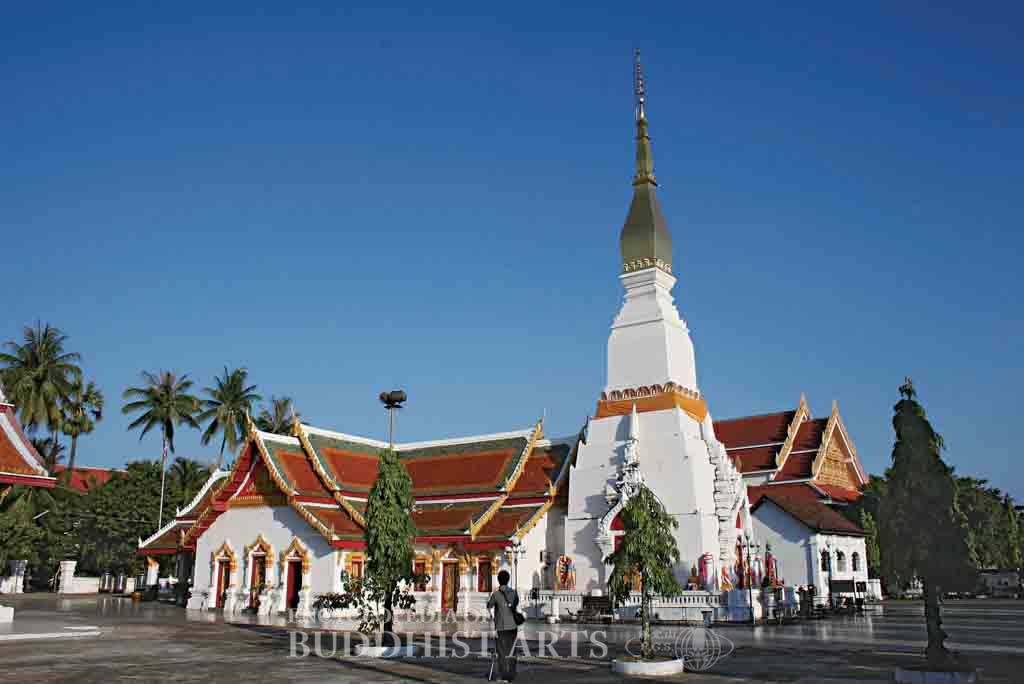
Wat Phra That Choeng Chum
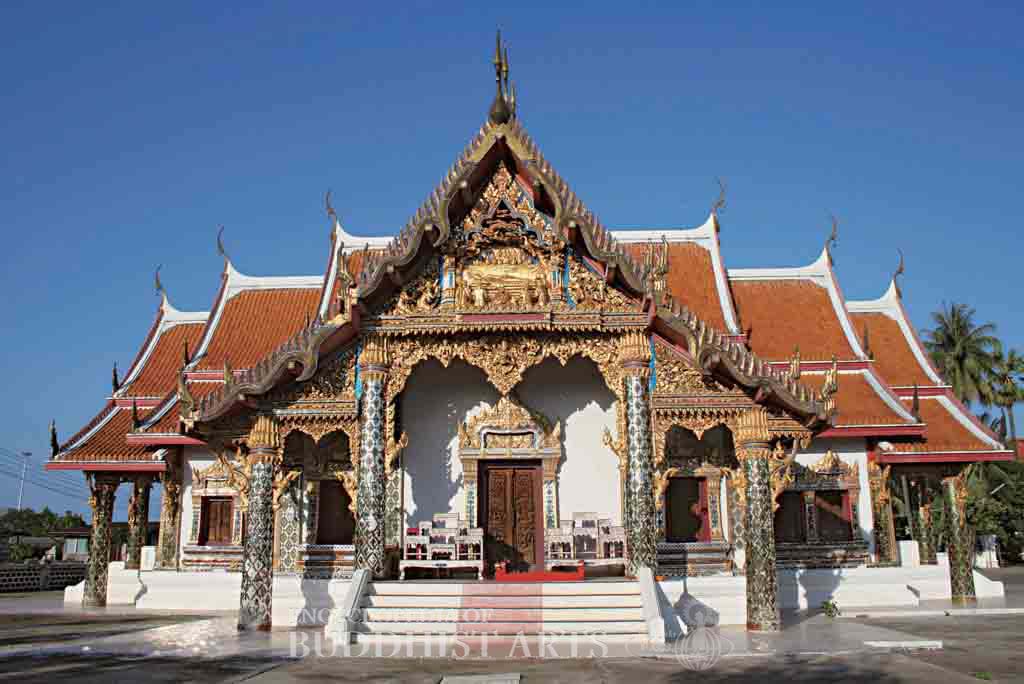
Wat Phra That Choeng Chum: Ordination Hall
Wat Phra That Choeng Chum
THAILAND, Sakon Nakhon
This temple’s full name is Phra That Choeng Chum Woraviharn, which is also the name of the main stupa at the temple. It means Stupa of the Gathering of the Footprints, because it was said to have been built above the footprints of four Buddhas. The stupa was erected in the 17th century over an 11th century Khmer-style stupa. It is a second class royal temple.
The temple’s important buildings include the stupa, ordination hall, main hall, and meditation hall. The stupa is built of bricks and mortar in the form of a square Lao-style stupa and has a height of 24 m. The base platform has multiple layers, with the four corners of each layer curled up slightly. The white body is decorated with a ring of lotuses at the bottom, and is surmounted by the base of the spire in the form of a Sumeru throne. The lowest section of the spire is shaped like a slender inverted square vase, which is replicated in a much smaller form above that. The finial consists of a small slender cone, a wish-fulfilling jewel, and canopy, all of which are gilded. The north, south, and east sides of the stupa are open with arched doorways. From these entrances one can see the original Khmer-style stupa housed within the stupa.
The layout of the ordination hall is square with multiple corners. It has a cruciform roof consisting of three overlapping ridge sections on each of the four sides. The naga bargeboards appear sturdy and robust. The relief carvings on the exterior are intricate, with the image of the Buddha entering parinirvana on the pediment being the most expressive.
The main hall is cruciform in layout and has a double overlapping roof. There is a gilded Buddha image named Luang Phor Phra Ong Saen enshrined within the hall.
For more details, go to the Encyclopedia of Buddhist Arts: Architecture T-Z, page 1240.
Cite this article:
author = Hsingyun and Youheng and Johnson, Peter and Mankuang and Lancaster, Lewis,
booktitle = {Encyclopedia of Buddhist Arts: Architecture T-Z},
pages = 1240,
title = {{Wat Phra That Choeng Chum}},
volume = 4,
year = {2016}}