
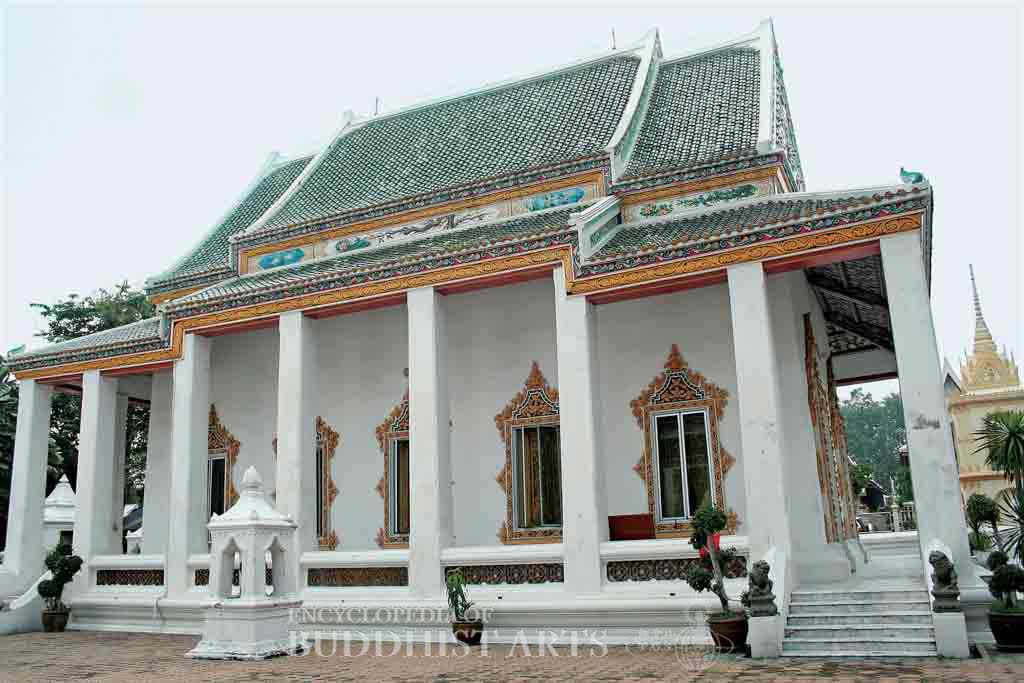
Wat Sam Phraya: Ordination Hall
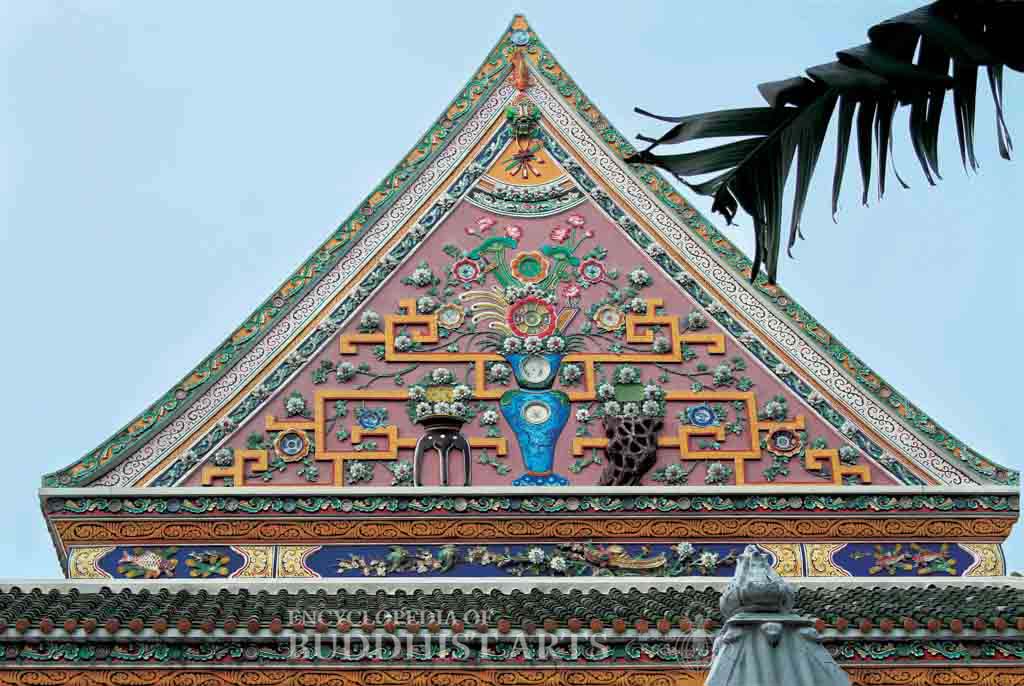
Wat Sam Phraya: Ordination Hall - Pediment
Wat Sam Phraya
THAILAND, Bangkok
Wat Sam Phraya means the Temple of Three Lords. The temple was built in the early 19th century by a nobleman in memory of his brother. It was renovated in 1823 by the nobleman’s three nephews who held the title of Phraya (Lord). They presented the temple to King Rama III (reigned 1824–1851). The king gave the temple its present name and listed it as a third class royal temple.
The temple consists of an ordination hall, main hall, lecture hall, six stupas, and monastic living quarters. The layout of the ordination hall is rectangular, with a veranda surrounding it. The roof has double-tier eaves and three sections of overlapping roofs. It is covered with green glazed tiles. The fascia board between the upper and lower roof is interestingly decorated with porcelain pieces and paintings. Most of the pediment is decorated with motifs, such as scrolling leaf patterns, vases, flowers, and simplified key patterns. A Buddha statue with hands in the bhumisparsa (earth-touching) mudra is enshrined within the ordination hall. The temple has distinct Chinese architectural elements, a characteristic of Buddhist temples from the Rama III period.
For more details, go to the Encyclopedia of Buddhist Arts: Architecture T-Z, page 1251.
Cite this article:
author = Hsingyun and Youheng and Johnson, Peter and Mankuang and Lancaster, Lewis,
booktitle = {Encyclopedia of Buddhist Arts: Architecture T-Z},
pages = 1251,
title = {{Wat Sam Phraya}},
volume = 4,
year = {2016}}