
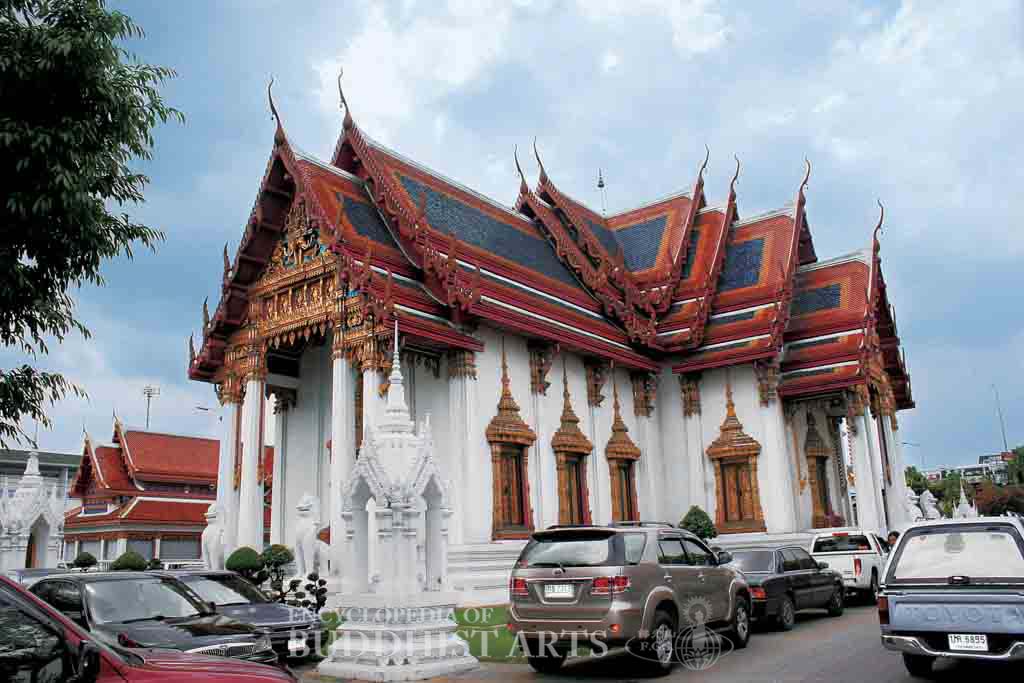
Wat Amarintraram: Ordination Hall
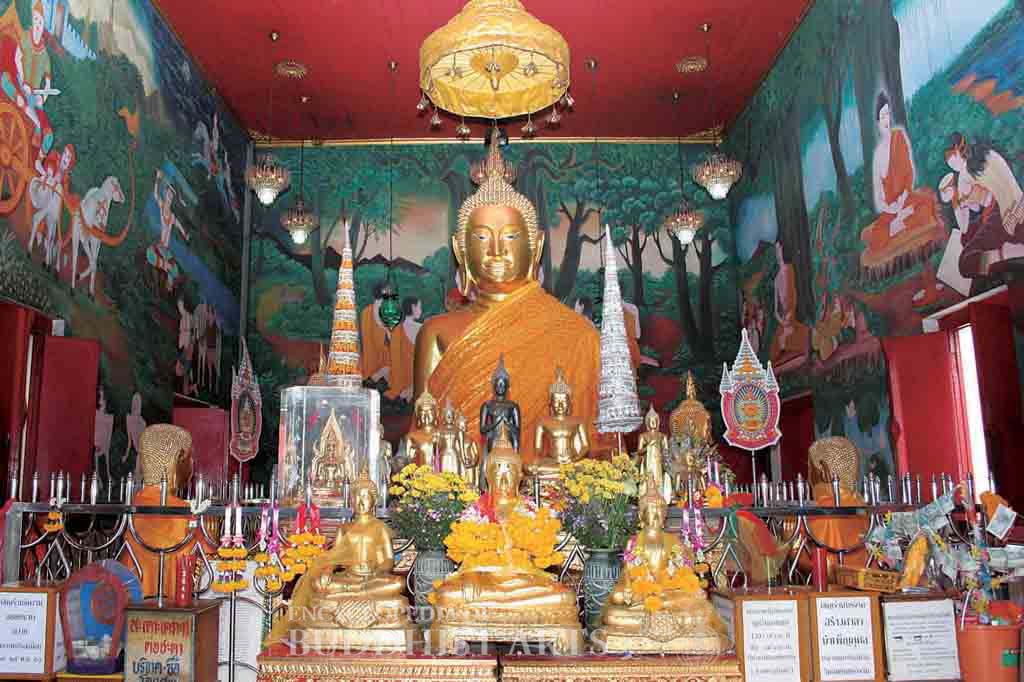
Wat Amarintraram: Ordination Hall (interior)
Wat Amarintraram
THAILAND, Bangkok
This is a third class royal temple with the full name Wat Amarintraram Woraviharn. It was built in the Ayutthaya period (1350–1767) with the original name Wat Bang Wa Noi. King Rama I (reigned 1782–1809) renovated the temple and renamed it Wat Amarintraram. It was renovated again by King Rama III (reigned 1824–1851). In 1949 the temple was restored after being heavily damaged.
The main structure of the temple is the ordination hall, which has a rectangular layout with a portico projecting from each of its four sides. It has a cruciform roof, with four overlapping ridges on each side of the roof. At the center of the roof, a pole supporting a multi-tier canopy forms a spire. The roof has triple-tier eaves and has glazed tiles in three different colors. The pediments are decorated with a three-headed elephant carrying a niche on its head. Inside the niche there is a seated Buddha surrounded by heavenly beings. Each portico roof is supported by four square columns with indented corners. The column capitals are decorated with inverted lotuses, with golden nagas stretching down to the midway point on one side of the columns. There are pairs of white guardian lions flanking the porticos. Enshrined within the ordination hall there is the main gilt bronze statue of a seated Buddha about 4 m high, with his hands in the bhumisparsa (earth-touching) mudra. There are also several seated and standing statues of various sizes placed before the main statue, which is a distinct feature of temples in Thailand.
For more details, go to the Encyclopedia of Buddhist Arts: Architecture T-Z, page 1181.
Cite this article:
author = Hsingyun and Youheng and Johnson, Peter and Mankuang and Lancaster, Lewis,
booktitle = {Encyclopedia of Buddhist Arts: Architecture T-Z},
pages = 1181,
title = {{Wat Amarintraram}},
volume = 4,
year = {2016}}