
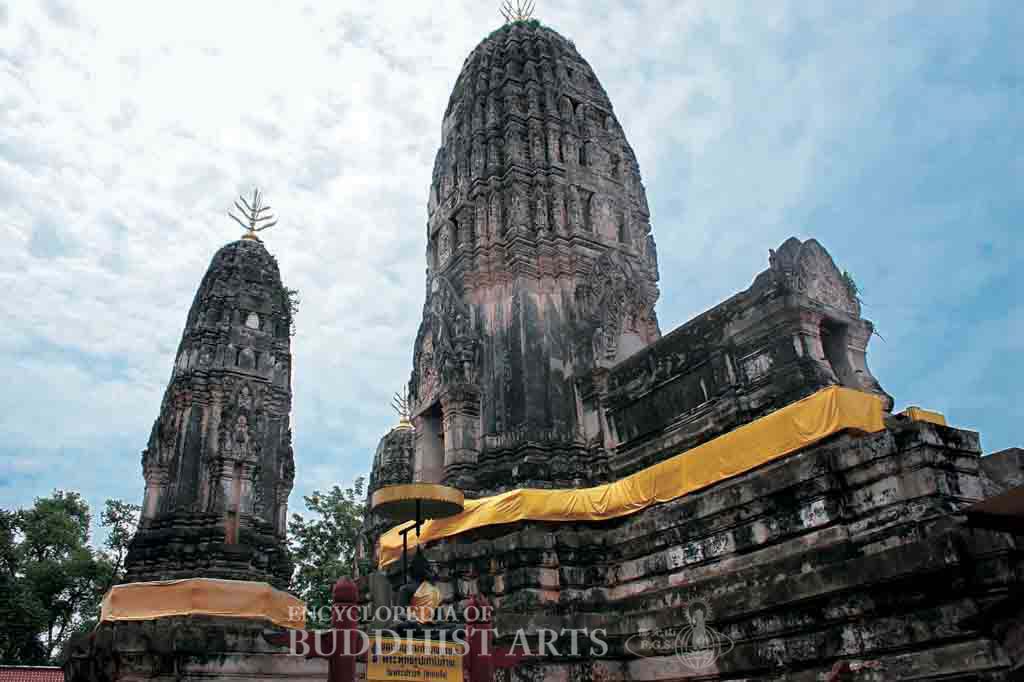
Wat Phra Sri Rattana Mahathat: Khmer-Style Stupas
Wat Phra Sri Rattana Mahathat
THAILAND, Ratchaburi
Known locally as Wat Na Phra That, the temple is located on the west bank of the Mae Klong River, and is one of the most important temples in Ratchaburi. The construction dates back to the 8th century of the Dvaravati period (6th–13th century). It was restored in the Ayutthaya period (circa 1350–1767).
Many Khmer-style stupas, a Buddha hall, and statues of the Buddha are extant on the site. The main stupa is surrounded by a smaller ancillary stupa on each of its four sides. They are erected on a rectangular base platform with multiple corners. All the stupas are made of brick and stone and have a tapered curved shape. The main stupa is 24 m high. A Sumeru throne rests on the base platform. The lower part of the body has multiple corners. There is a door on each of the four sides, but only one prominent portico projecting from the main entrance. The double tympana above the doorways feature particularly delicate relief carvings. The upper part of the body consists of eight tiers narrowing in height and tapering towards the top. Each tier is decorated with relief carvings.
Around the stupa there are Buddha statues sculpted in the Dvaravati, Lopburi, and Ayutthaya periods, which reflects the heritage of Buddhist art in Thailand.
For more details, go to the Encyclopedia of Buddhist Arts: Architecture T-Z, page 1235.
Cite this article:
author = Hsingyun and Youheng and Johnson, Peter and Mankuang and Lancaster, Lewis,
booktitle = {Encyclopedia of Buddhist Arts: Architecture T-Z},
pages = 1235,
title = {{Wat Phra Sri Rattana Mahathat}},
volume = 4,
year = {2016}}