

Wat Mahathat
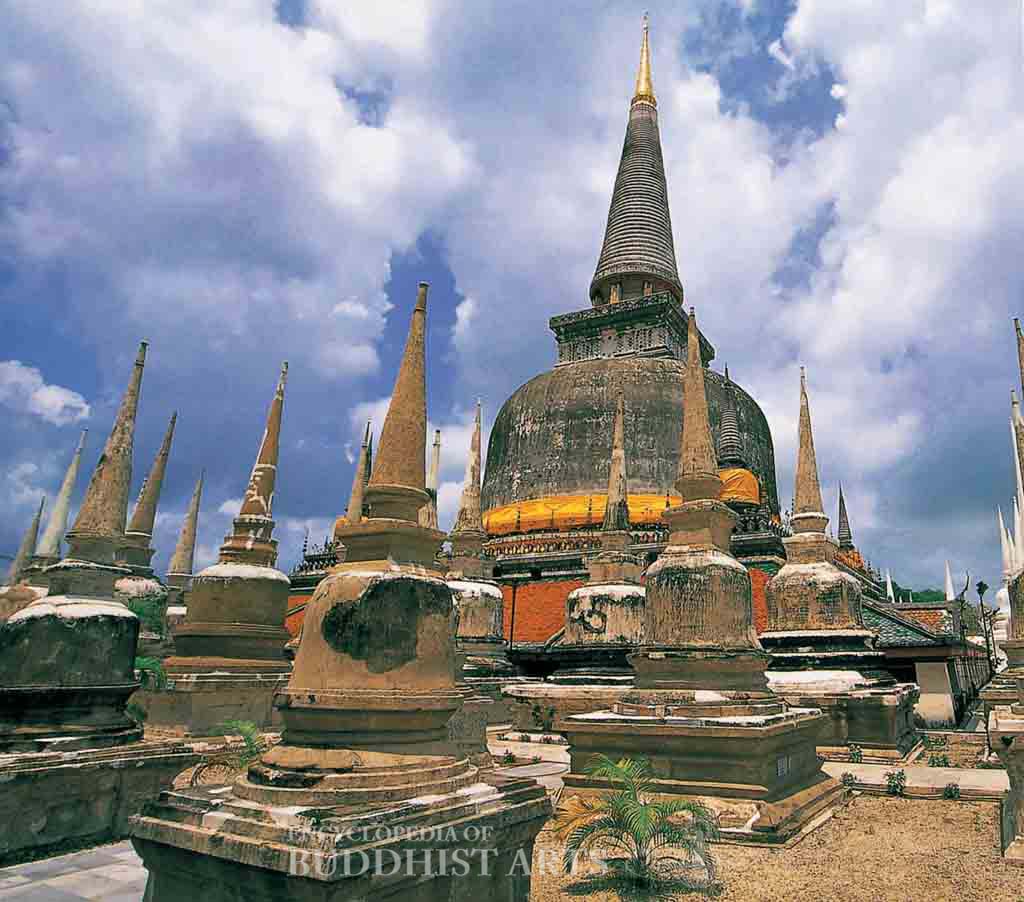
Wat Mahathat: Main Stupa
Wat Mahathat
THAILAND, Nakhon Sri Thammarat
Wat Phra Mahathat means Temple of the Great Relics. It is one of the oldest and most revered temples in southern Thailand. It is a first class royal temple with the full name of Wat Phra Mahathat Woramahawihan. The exact founding date of the temple is unknown. A Thai-style stupa is said to have been built in 757 and in the 13th century a larger Sri Lankan style stupa was built on top of it. A number of other buildings were added at that time, turning it into a temple complex. In 1915 King Rama VI (reigned 1910–1925) instructed the governor to invite monks to reside at the temple and since then, it has remained a monastery.
The temple entrance faces east and there is a rectangular courtyard inside. The major buildings run along the north-south axis and include the ordination hall, main stupa, museum, and the main Buddha hall. The ordination hall, built in the 17th century, has two rows of white painted columns supporting the ceiling. Their capitals are in the form of lotuses. The red coffered ceiling is decorated with golden lotuses in bloom, giving the hall a sense of grandeur. The ordination hall houses a seated Sakyamuni Buddha statue, flanked by two disciples facing each other with joined palms.
The main stupa is 55.8 m high and is said to contain relics brought from Sri Lanka. The base is surrounded by a colonnade lined with Buddha statues. The stupa body is in the shape of an inverted bowl. Above the square harmika, there is a ring of small columns supporting the spire. The stacked rings of the spire taper towards the gold finial. On the north side of the stupa, there is a covered gallery lined with many Buddha statues on both sides, leading to the base platform of the main stupa. The museum exhibits historical artifacts from the temple. The Buddha hall to the north of the museum contains a statue of the Reclining Buddha. There are 156 stupas scattered within the temple courtyard.
For more details, go to the Encyclopedia of Buddhist Arts: Architecture T-Z, page 1204.
Cite this article:
author = Hsingyun and Youheng and Johnson, Peter and Mankuang and Lancaster, Lewis,
booktitle = {Encyclopedia of Buddhist Arts: Architecture T-Z},
pages = 1204,
title = {{Wat Mahathat}},
volume = 4,
year = {2016}}