
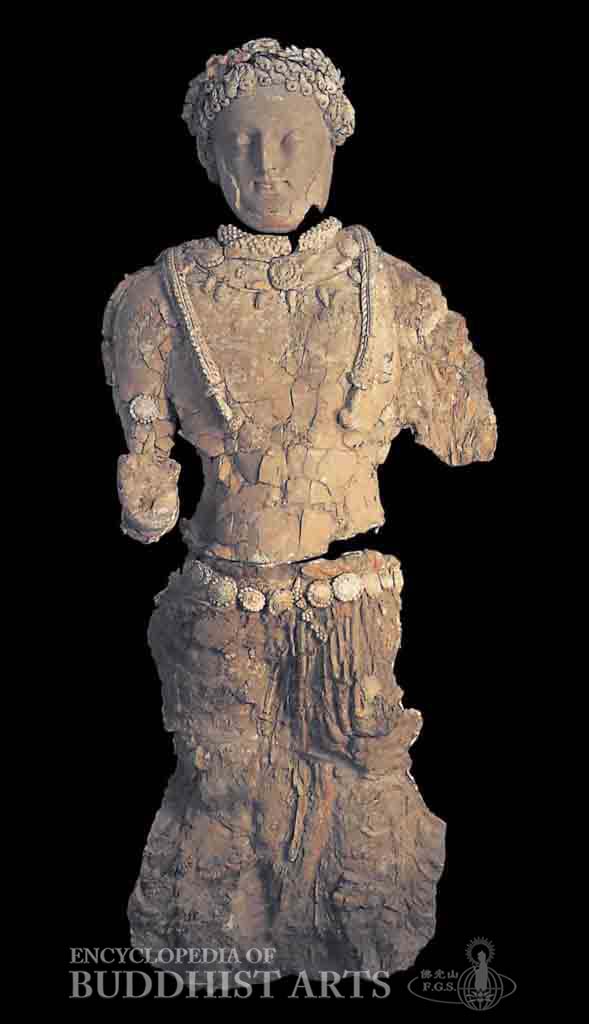
Dalverzin Tepe: Standing Bodhisattva
Clay
Dalverzin Tepe: Standing Bodhisattva
UZBEKISTAN, Surkhandarya, Termez
The statue is thought to date from the time of the Sassanid period (224–651), during which Termez remained a major Buddhist city. The sculpture was considerably damaged, broken into three sections, and much of the limbs are missing. The finely curled, individually molded ringlets on the head most likely reflect the local style. Necklaces and various other ornaments adorn the chest. The ornamentation was created separately then applied to the statue. The folds of the lower garment adapt themselves to the shape of the legs and contribute to a sense of movement.
For more details, go to the Encyclopedia of Buddhist Arts: Sculpture A-F, page 283.
Cite this article:
Hsingyun, et al. "Dalverzin Tepe: Standing Bodhisattva." Encyclopedia of Buddhist Arts: Sculpture A-F, vol. 10, 2016, pp. 283.
Hsingyun, Youheng, Yann Lovelock, Yuan Chou, Susan Huntington, Gary Edson, and Robert Neather. 2016. "Dalverzin Tepe: Standing Bodhisattva" In Encyclopedia of Buddhist Arts: Sculpture A-F, 10:283.
Hsingyun, Youheng, Lovelock, Y., Chou, Y., Huntington, S., Edson, G., & Neather, R.. (2016). Dalverzin Tepe: Standing Bodhisattva. In Encyclopedia of Buddhist Arts: Sculpture A-F (Vol. 10, pp. 283).
@misc{Hsingyun2016,
author = Hsingyun and Youheng and Lovelock, Yann and Chou, Yuan and Huntington, Susan and Edson, Gary and Neather, Robert,
booktitle = {Encyclopedia of Buddhist Arts: Sculpture A-F},
pages = 283,
title = {{Dalverzin Tepe: Standing Bodhisattva}},
volume = 10,
year = {2016}}
author = Hsingyun and Youheng and Lovelock, Yann and Chou, Yuan and Huntington, Susan and Edson, Gary and Neather, Robert,
booktitle = {Encyclopedia of Buddhist Arts: Sculpture A-F},
pages = 283,
title = {{Dalverzin Tepe: Standing Bodhisattva}},
volume = 10,
year = {2016}}