
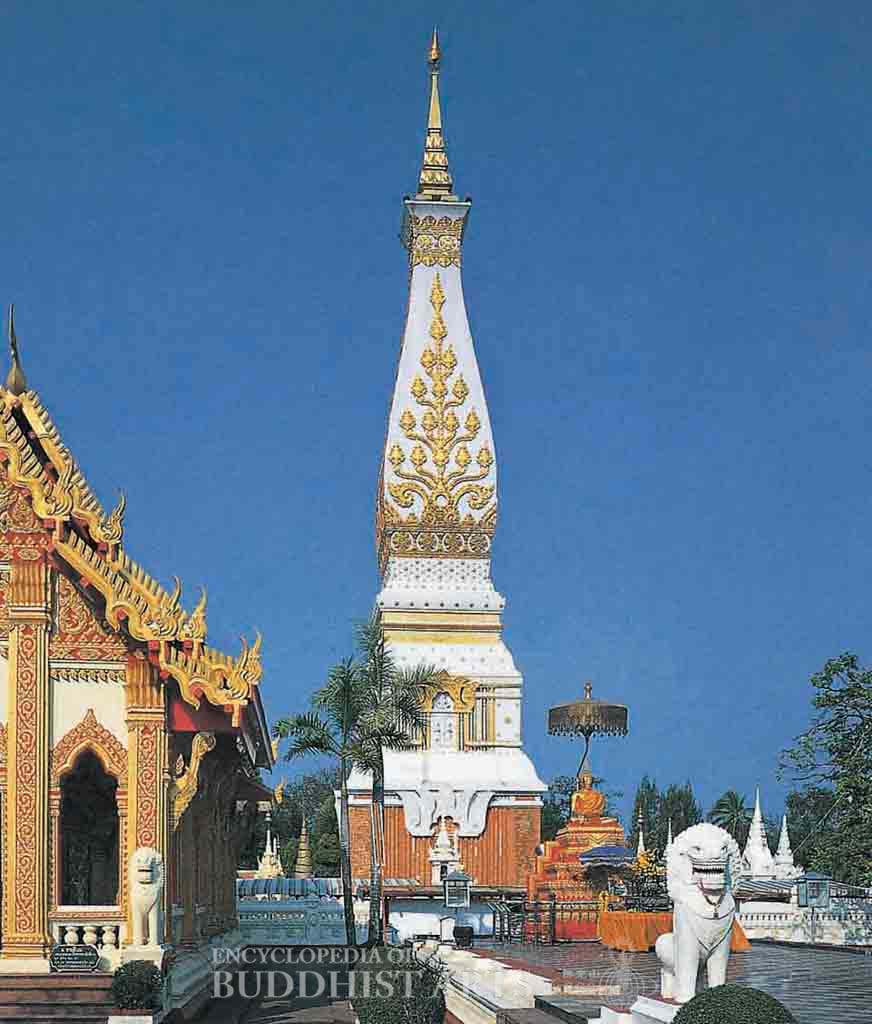
Wat Phra That Phanom
Wat Phra That Phanom
THAILAND, Nakhon Pathom, That Phanom
Phra That Phanom means Stupa on the Hill. The Buddha’s breastbone relic is enshrined within the stupa. There is a local legend that the temple was constructed shortly after the Buddha’s parinirvana; however, archaeologists date the earliest structures to between the 6th and 10th centuries. It subsequently underwent numerous renovations and expansions. The stupa was originally built in Khmer style, but in 1690 it was completely reconstructed in Lao style. It collapsed in 1975 and was then rebuilt. The temple is a first class royal temple.
The temple is surrounded by walls with covered corridors and consists of the stupa, main hall, and bell tower. The stupa is an imitation of the Phra That Luang in Vientiane in Laos. It is a brick stupa approximately 57 m high with an undecorated square base with a width of 12.3 m. While the lower sections have a square layout, the elongated body resembles a slender inverted vase, giving the stupa an elegant, curvilinear appearance. The stupa body is painted in white and decorated with golden floral motifs. The spire consists of three truncated pyramid tiers surmounted by a miniature version of the body, followed by a series of canopies. The spire is made of 110 kg of solid gold. The stupa is surrounded by smaller stupas and encircled by a low boundary wall.
For more details, go to the Encyclopedia of Buddhist Arts: Architecture T-Z, page 1246.
Cite this article:
author = Hsingyun and Youheng and Johnson, Peter and Mankuang and Lancaster, Lewis,
booktitle = {Encyclopedia of Buddhist Arts: Architecture T-Z},
pages = 1246,
title = {{Wat Phra That Phanom}},
volume = 4,
year = {2016}}