
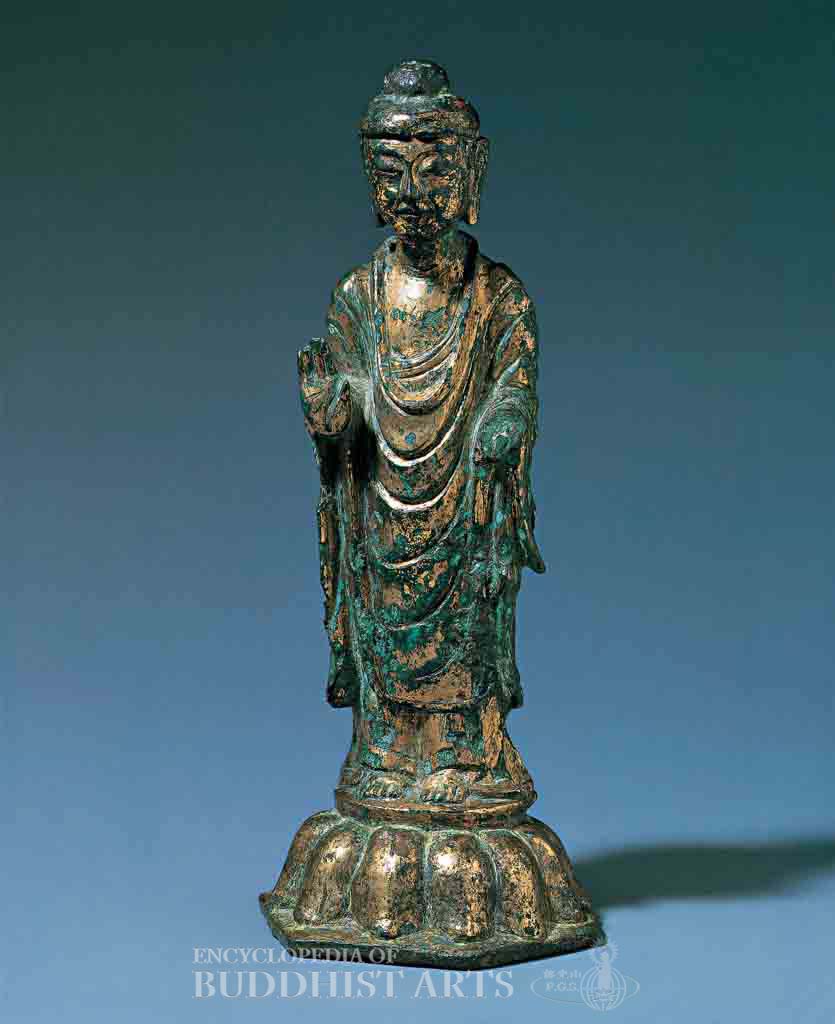
Suksusa Temple: Standing Buddha
Gilt bronze
Suksusa Temple: Standing Buddha
SOUTH KOREA, North Gyeongsang, Yeongju; Silla dynasty
This sculpture is one of 25 bronzes excavated from the ruins of Suksusa Temple in 1953 and is assumed to have been cast in the first half of the 7th century.
The slim figure stands on an inverted lotus pedestal. Signs of Buddhahood include a flattened usnisa, elongated earlobes, and three lines on the neck. The monastic robe covers both shoulders and hangs in deep folds, with a rippling effect at the sides where the material falls from the arms. The right hand is raised in abhaya (fearlessness) mudra while the corroded left hand seems to form the varada (wish-granting) mudra.
For more details, go to the Encyclopedia of Buddhist Arts: Sculpture St-Z, page 1174.
Cite this article:
Hsingyun, et al. "Suksusa Temple: Standing Buddha." Encyclopedia of Buddhist Arts: Sculpture St-Z, vol. 13, 2016, pp. 1174.
Hsingyun, Youheng, Yann Lovelock, Yuan Chou, Susan Huntington, Gary Edson, and Robert Neather. 2016. "Suksusa Temple: Standing Buddha" In Encyclopedia of Buddhist Arts: Sculpture St-Z, 13:1174.
Hsingyun, Youheng, Lovelock, Y., Chou, Y., Huntington, S., Edson, G., & Neather, R.. (2016). Suksusa Temple: Standing Buddha. In Encyclopedia of Buddhist Arts: Sculpture St-Z (Vol. 13, pp. 1174).
@misc{Hsingyun2016,
author = Hsingyun and Youheng and Lovelock, Yann and Chou, Yuan and Huntington, Susan and Edson, Gary and Neather, Robert,
booktitle = {Encyclopedia of Buddhist Arts: Sculpture St-Z},
pages = 1174,
title = {{Suksusa Temple: Standing Buddha}},
volume = 13,
year = {2016}}
author = Hsingyun and Youheng and Lovelock, Yann and Chou, Yuan and Huntington, Susan and Edson, Gary and Neather, Robert,
booktitle = {Encyclopedia of Buddhist Arts: Sculpture St-Z},
pages = 1174,
title = {{Suksusa Temple: Standing Buddha}},
volume = 13,
year = {2016}}