
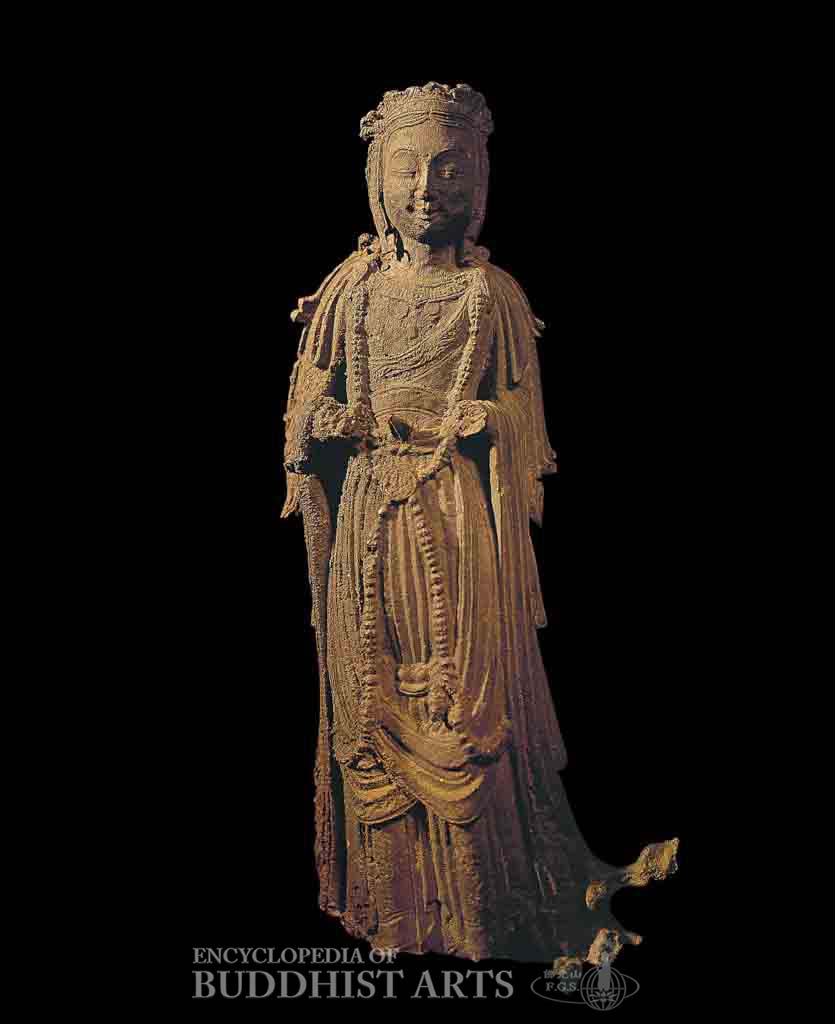
Sekiyama Shrine: Standing Bodhisattva
Bronze
Sekiyama Shrine: Standing Bodhisattva
JAPAN, Niigata, Myoko; Asuka period
The figure was cast in bronze during the 7th century but has suffered much damage. It was probably brought to Japan by immigrant Korean artisans. It shows the extent of Chinese stylistic influence on the Korean Peninsula at the time. This stylistic influence is indicated by details such as the long bead ornament crossing at a jade medallion below the waist and the forward jut of the Bodhisattva’s hips, creating an elegantly flexed profile. A ribbon fillet frames the serenely smiling face with its long parted hair. Stoles drape the arms as they form a double loop across the skirt and emphasize its vertical folds.
For more details, go to the Encyclopedia of Buddhist Arts: Sculpture N-Sr, page 1038.
Cite this article:
Hsingyun, et al. "Sekiyama Shrine: Standing Bodhisattva." Encyclopedia of Buddhist Arts: Sculpture N-Sr, vol. 12, 2016, pp. 1038.
Hsingyun, Youheng, Yann Lovelock, Yuan Chou, Susan Huntington, Gary Edson, and Robert Neather. 2016. "Sekiyama Shrine: Standing Bodhisattva" In Encyclopedia of Buddhist Arts: Sculpture N-Sr, 12:1038.
Hsingyun, Youheng, Lovelock, Y., Chou, Y., Huntington, S., Edson, G., & Neather, R.. (2016). Sekiyama Shrine: Standing Bodhisattva. In Encyclopedia of Buddhist Arts: Sculpture N-Sr (Vol. 12, pp. 1038).
@misc{Hsingyun2016,
author = Hsingyun and Youheng and Lovelock, Yann and Chou, Yuan and Huntington, Susan and Edson, Gary and Neather, Robert,
booktitle = {Encyclopedia of Buddhist Arts: Sculpture N-Sr},
pages = 1038,
title = {{Sekiyama Shrine: Standing Bodhisattva}},
volume = 12,
year = {2016}}
author = Hsingyun and Youheng and Lovelock, Yann and Chou, Yuan and Huntington, Susan and Edson, Gary and Neather, Robert,
booktitle = {Encyclopedia of Buddhist Arts: Sculpture N-Sr},
pages = 1038,
title = {{Sekiyama Shrine: Standing Bodhisattva}},
volume = 12,
year = {2016}}